Crossing the ‘Valley of Death’ in Deep Tech: How Founders Can Navigate the Leap to Growth-Stage Funding
Stifel Bank Insights | Venture Banking

Forge Series highlights the founders and experts driving deep tech innovation. Hosted by Stifel Bank’s Venture Banking team, these conversations explore industry trends, investment insights, and the challenges of building transformative companies. The series sets the stage for and builds on the annual FORGE Conference, a gathering of top deep tech founders, investors, and executives.
Jocelyn Kinsey, Partner at DFJ Growth, breaks down what it takes for deep tech founders to move from early validation to growth—aligning milestones, customers, and storytelling to cross the funding “valley of death.”
Inside the Growth-Stage Playbook for Deep Tech Founders
Following our FORGE conference, I sat down with Jocelyn Kinsey, Partner at DFJ Growth, to continue the conversation she sparked in her session on one of the hardest transitions in our industry: moving from early validation to growth-stage funding in deep tech.
For founders building in complex, capital-intensive markets, this is the moment where trajectories diverge—where some teams build momentum and others stall.
Deep tech founders know this leap is difficult, but many underestimate why.
“Deep tech is hard for a reason,” Jocelyn said. “You need real breakthroughs across multiple functional disciplines, the ability to scale production and manufacturing, a repeatable go-to-market motion in often slow-moving industries, and disciplined cash-flow management to manage the capital intensity that comes with building physical products.”
“But that difficulty is also the advantage—it creates real, compounding moats.”
Why the Valley Is More Difficult in Deep Tech
Unlike SaaS, there is no universal dashboard of growth metrics for deep tech. Founders migrate from technology readiness, prototype maturity, and early pilots into a world where investors expect paying customers who love the product and clear expansion pathways.
The mismatch between early vision-driven valuations and later execution-driven expectations creates the familiar “valley of death.”
This isn’t a failure of the science. It’s the reality of commercial adoption.
“New markets don’t happen overnight,” Jocelyn said. “Even if a technology is ready, the rate at which markets can absorb new technology often takes longer than people expect.”
At Stifel Bank, we see this firsthand. Breakthroughs often appear “late” to founders but “early” to customers, who must integrate new systems, shift workflows, or absorb significant cost before adoption. Market readiness is a separate milestone from technical readiness.
What Great Deep Tech CEOs Do Differently
Jocelyn described a pattern she sees across the strongest deep tech founders.
“They aren’t just riding the wave,” she said. “They’re helping create the wave. They can see the future and are committed to building it.”
These CEOs excel at phased storytelling—articulating an ambitious long-term vision while clearly defining near-term commercial opportunities that they are already executing against. They know how to frame the end-state while delivering sequential steps that derisk the journey and give them the right to win.
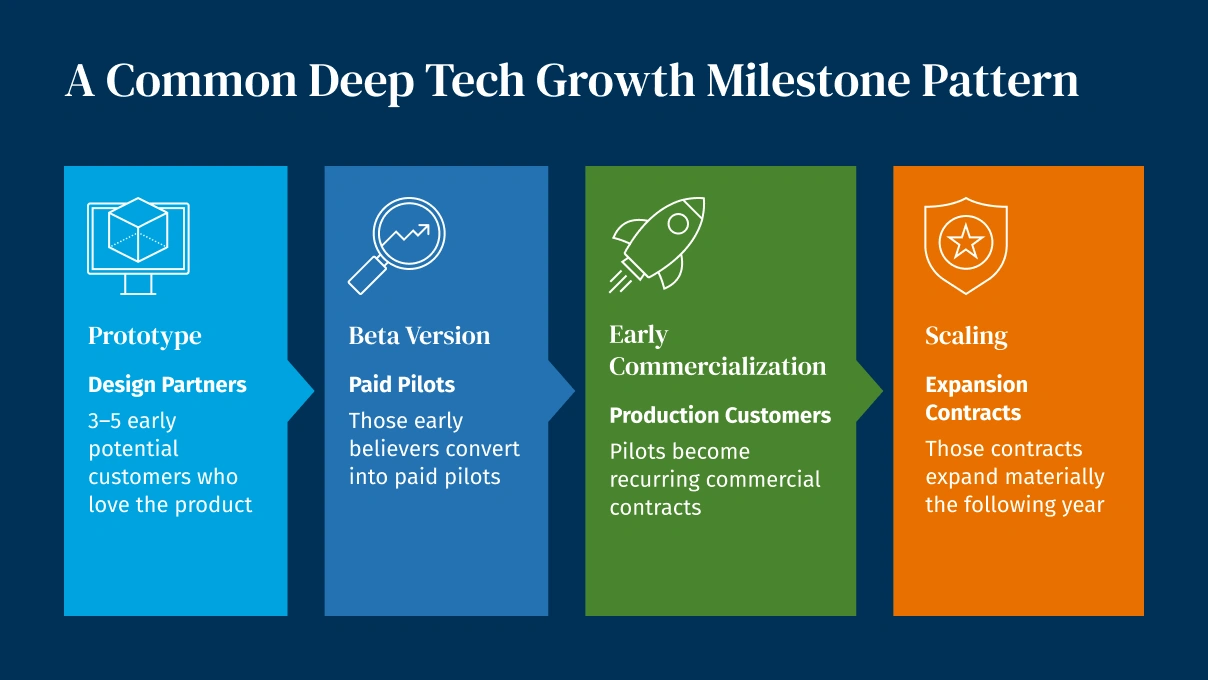
From Stifel Bank’s vantage point, another differentiator is customer strategy. Building alongside a small number of design partners early on can help founders validate the product and value proposition in real operating environments, and work through integration and deployment challenges ahead of scaling. Mid-sized customers can be strong initial partners because they often resemble the broader market and move quickly; starting with the largest customers can push teams toward bespoke solutions that don’t scale.
These focused deployments can also serve as investor references, helping validate the market opportunity and commercial demand ahead of meaningful revenue traction. Investors are looking for signals that a product is a “must-have,” not a “nice-to-have”—evidence that customers are willing to deploy, depend on, and advocate for it, rather than simply experiment with it
What Growth Investors Actually Look For
DFJ Growth’s evaluation framework is straightforward: the technology must work, there must be early signs of delighted customers, and there must be a visible path to scale. At this stage, it is largely about execution risk versus technical or market risk.
Founders often assume this is purely about product and engineering. In reality, the bar is just as high for communication.
“The hallmark of a great CEO is being able to translate complex technical concepts into a simple storyline and vision ….. make it retail,” Jocelyn said. “If a founder can’t do this, they will likely have a harder time recruiting top talent and landing large customers.”
This ability to translate complexity without diluting substance is one of the strongest predictors of fundraising success.
Founders don’t need to simplify the tech, but they do need to clarify the commercial story.
Milestones, Valuations, and the Valley of Death
Many deep tech companies raise early capital at lofty valuations anchored in vision and technical promise. But as programs move from R&D into scaling, the bar shifts quickly from what could work to what is working.
“We’re big fans of milestone-based financing strategies,” Jocelyn said. “It aligns founders and investors around funding toward a clear value inflection grounded in real progress, and reduces the risk of painful resets when the market shifts from rewarding promise to demanding validation.”
Milestone-based raises demonstrate discipline, reduce valuation dislocation, and allow investors to track execution over time. They also establish a shared expectation between founders and partners: what do we need to achieve for the next raise to happen at an increased valuation?
Why Investor–Founder Fit Matters More Than Ever
Because deep tech timelines are long, relationship building over time is critical. Investors want to see how you execute against your roadmap and plan. It’s also why technically fluent partners are so important.
“We’re specialists who are highly technical and long-term oriented,” Jocelyn said. “We understand how hard it is to scale deep tech companies, and are there as partners to guide through the inevitable speed bumps.”
A founder should do as much diligence on their investors as their investors do on their company—because the relationship will last just as long.
Why This Is a Moment for Deep Tech
Today’s deep tech momentum isn’t theoretical. It’s visible in the companies defining the next decade of innovation.
“We’ve seen firsthand how deep tech can create outsized value as an early growth investor in Tesla, SpaceX, Anduril, OpenAI, and others,” she said. “Recent breakthroughs in AI are enabling intelligent systems to automate services in the physical world, unlocking massive, long-overlooked markets and paving the way for a new generation of category-defining companies.”
From robotics to energy systems to industrial automation, AI is compressing timelines and expanding what’s commercially possible.
The Hard-Won Lessons Growth-Stage Deep Tech Founders Should Know
Across our collective experience—DFJ Growth as a long-term deep tech investor and Stifel Bank as a partner to founders from seed through IPO—we consistently see three behaviors that set successful companies apart:
- Lead with clarity, not complexity: Founders who break through can translate deep technical work into a clear commercial narrative. They connect what they’re building today to why it matters for customers now, and how it scales over time. Strong storytelling builds confidence with investors, customers, and talent long before the numbers fully show up.
- Raise to milestones, not months on a calendar: Timelines slip. Funding around concrete technical and commercial milestones creates alignment, reduces valuation friction, and keeps momentum through inevitable delays.
- Choose partners, not just valuations: Optimize for investors who understand the realities of scaling deep tech and are committed to the long game. The right partners stay engaged when things get hard, help sharpen your story with customers and the market, and support the milestones that compound value.
Crossing the valley of death is hard but not impossible. With the right customers, the right milestones, and the right partners, deep tech companies can convert scientific breakthroughs into enduring market leadership.
Written by

Tess Hatch
Managing Director
Related Insights
Other articles designed to help you along your financial journey.