Inside a New Model for Defense Tech: A Q&A with Julie Bush of Valinor
Venture Banking
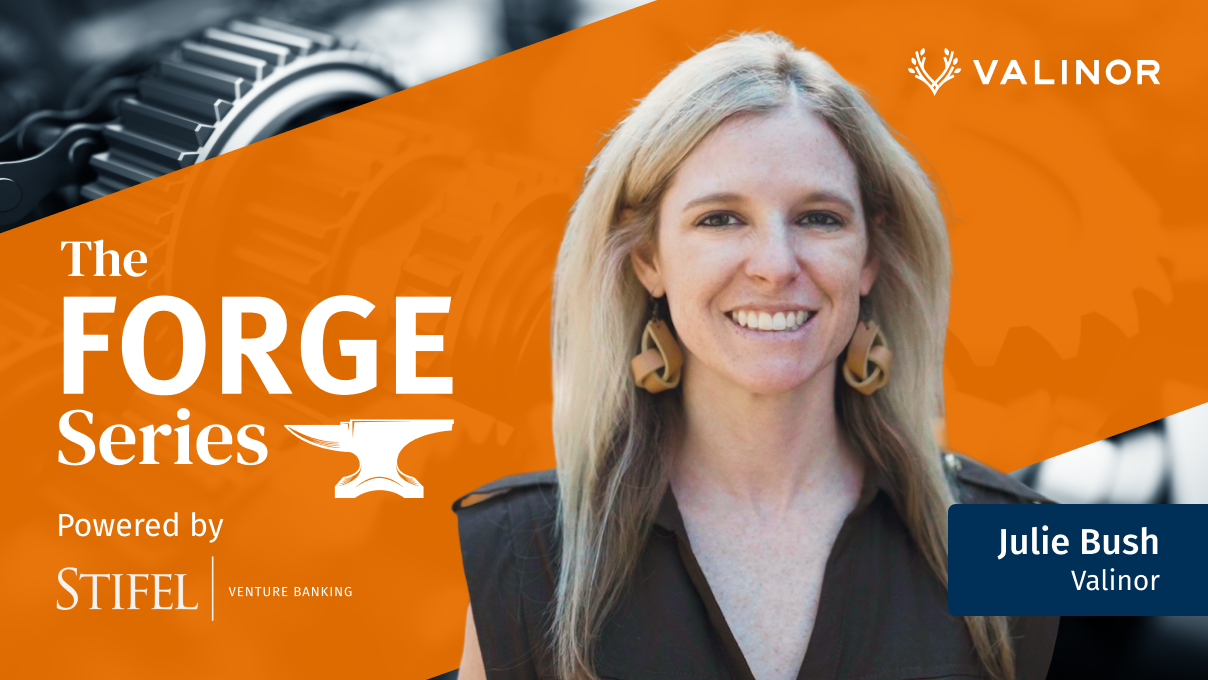
The Forge Series highlights the founders and experts driving Deep Tech innovation. Hosted by Stifel Bank’s Venture Banking team, these conversations explore industry trends, investment insights, and the challenges of building transformative companies. This piece builds on a conversation with Julie Bush, Co-Founder and CEO of Valinor.
Valinor Enterprises is a venture-backed holding company built to solve defense tech’s less glamorous problems: the “picks and shovels” capabilities that may not fit a traditional venture model but are still critical to government missions. Rather than building one company at a time, Valinor centralizes go-to-market, compliance, and operations, while engineering teams operate within majority-owned subsidiaries called Product Companies.
Before founding Valinor, Co-Founder and CEO Julie Bush spent 11 years at Palantir, where she helped build its government business, after beginning her career on Capitol Hill.
Stifel Bank Managing Director Al Guerrero sat down with Julie to talk through Valinor’s model, how the company decides what to build versus buy, and where it’s headed next. This interview has been edited for length and clarity.
Julie Bush
Company: Valinor Enterprises
Role: Co-Founder and CEO
Focus: Building defense tech Product Companies through a centralized go-to-market and operating model
Experience: Capitol Hill (Senator George Voinovich & House Appropriations); Palantir, 11 years
Fun fact: Julie is a former gymnast and self-described “massive elite gymnastics fan” who just bought tickets to the LA 2028 Olympics
Q: You’ve got a pretty nonlinear path here – Capitol Hill, then Palantir, now Valinor. Can you walk us through that arc?
Julie Bush: My career pathway is super nonlinear, and I’m a huge fan of not really planning too far in advance, because you never know where you’re going to end up. I started on Capitol Hill during law school, working for my home-state Senator, George Voinovich, on the Homeland Security and Government Affairs committee. I loved it. I thought I’d be on the Hill for the next ten years.
Then, during the 2013 government shutdown, I got a call from a friend who was an early employee at Palantir. I didn’t even know what Palantir was. I went to state schools and wasn’t in tech, but I got on a plane, and the next morning I met Alex Karp. That was my first interview. Twenty days later, I had an offer. It felt serendipitous, and I’m a big believer in following your intuition when something feels right. I joined in December 2013 and stayed 11 years. I built a lot of the government business there.
I thought I’d be a Palantir lifer, honestly. But, similarly, I got a call while I was out on parental leave with my second daughter from Paul Kwan at General Catalyst and Trae Stephens at Founders Fund. I started talking to them in early 2024 about the need for a new business model in defense tech, and ultimately decided to rip the Band-Aid. What I’m building now is really a culmination of everything I observed being in the defense tech and DC world for the last 15-plus years.
Q: What problems did you see in defense tech that convinced you there was a need for a different model?
Julie Bush: There are really two, related problems. One is go-to-market, and the other is what that incentivizes in terms of which problems people go after.
Selling to government is genuinely hard and expensive. The landscape of buyers is always shifting, and it takes real nuance to do successfully. Because it’s so hard and so expensive, historically the only way to fund new products for this market has been venture capital, which is necessary, including for Valinor. But venture capital comes with heuristics: you need a large addressable market, which in government usually means you’re chasing the moonshot problems – Golden Dome, next-gen fighter jets, new ships, rockets. Those are all really critical problems, and they’re right for venture capital.
But, the vast majority of what the government actually needs is what I call picks and shovels. There was no model built to support those capabilities or give the right exits to the companies building them. That’s why Valinor exists.
“The vast majority of what the government actually needs is what I call picks and shovels. There was no model built to support those capabilities or give the right exits to the companies building them. That’s why Valinor exists.”
Q: How does Valinor’s model work in practice? You’ve described it as “centralized go-to-market, decentralized engineering.”
Julie Bush: In one sentence, that’s exactly it. We have a venture-backed holding company, Valinor Enterprises, Inc., with three functions: it’s the capital allocator, the commercialization engine, and it runs all company operations – people, finance, legal, compliance, even shared tech stacks for things like DevSecOps.
Then, we decentralize product and engineering into majority-owned subsidiaries. Valinor Enterprises is the majority owner, with the remaining upside held in an equity pool that the General Manager of said Product Company can allocate across the team. That structure is really what drives speed to value; we’re splitting company-building in half in a way that incentivizes everyone across the ecosystem to move fast.
Q: Are there comparables in other industries? What are you borrowing from?
Julie Bush: I get a new comp every day. The model has been proven elsewhere, like BridgeBio and Roivant in biotech, and Joyride Games in video games. And there’s financial services companies like Berkshire Hathaway, although we’re structured differently because our holding company is highly operational. We’re building a conglomerate from the ground up. I think we’re in the rise of the operational holding company. That word “operational” matters, because we’re more owner-operator than investor.
Q: What’s actually hard about running this structure day-to-day?
Julie Bush: We operate as one ecosystem. You walk into our office and it feels like one tech company. But you do have a lot of people across different entities, and I’m a real believer in flat cultures, which I grew up in at Palantir. We’ve had to build more structure here earlier than I’d like, just because we have so many entities growing at once.
At the end of the day, it comes down to incentivizing the right behavior. Our Product Companies are like horses on a racetrack; we fund them quarterly, based on a quarterly business review, just like a product line at any other company. One real learning: we now give GMs equity in the holding company itself, not just their own subsidiary, because a lot of hub-and-spoke models don’t do that, and you need people to still feel connected to the broader ecosystem.
Q: What does shared infrastructure mean for speed in practice?
Julie Bush: The clearest example of speed is that for Valinor Product Companies, the timeline from incorporation to first contract is usually four to six months. That’s fast. And it’s because we only start a new product company when there’s concrete demand signal. We know what the solution needs to be before we even start. We also only look at product development cycles under six months, and that helps inform whether we build or acquire.
The second piece is process. We already have the registrations and compliance work done. Several customers are already teed up. Most new startups have to go hire their own finance team, legal team, BD team, and product team. Recruiting alone takes real time, and not many people have actually lived this and crossed that valley. This team already exists at Valinor. We’ve built the best government go-to-market team I know, and it’s fully centralized. We have one Army portfolio lead who brings our entire portfolio to that relationship. A lot of times, one customer for one product company becomes a customer for another. The flywheel compounds.
Harbor is a good example. We closed a Department of War contract with a particular customer in Q2, and this quarter we’re seeing two more orders from that same customer.
“We’ve built the best government go-to-market team I know, and it’s fully centralized.”
Q: You mentioned contracting vehicles as another way the model can accelerate growth. How does that work?
Julie Bush: You typically need a pre-negotiated contract already in place, with a price list attached, that lets the government purchase your product over and over. If you don’t have that vehicle, it’s genuinely hard to sell anything. That’s how a lot of companies get locked out of government entirely. Because we can craft contracting vehicles that multiple product companies can use, new products can plug into existing infrastructure.
Q: Let’s talk build versus buy. How do you think about M&A?
Julie Bush: It comes down to speed every time. When we’re deciding whether to stand up a new product company, we look at three things: the quality and speed of the government demand signal (government is risk-averse until you find a champion with real urgency); how quickly we can source the solution, build or acquire; and how fast we can prototype and prove it to the government, because if you can’t deliver, that sales cycle dies.
We haven’t completed an acquisition yet, but you’ll see us do one in the next six months. I intentionally didn’t consider corporate development until after our Series A, which closed the last week of 2025. I wanted to prove out the model first. We’ve diligenced hundreds of companies at this point.
I think this is an interesting time in defense tech. I wouldn’t call it a buyer’s market yet, but I do think Valinor becomes even more valuable once some of the hype dies down. A lot of these new startups are going to need a home. Some may end up having over-raised to the point where there isn’t a realistic exit for them.
You don’t have to go to zero, but you also don’t need to live that IPO dream. That matters because these capabilities still need to stick around for the warfighter, and we can be a home for them.
Q: How does culture factor into the way you evaluate a potential acquisition?
Julie Bush: It’s probably the number one thing. When I started this, plenty of people told me to go buy, buy, buy – that’s how you grow fast. Shyam Sankar, Palantir’s CTO, always used to say, “Talent eats culture for breakfast”, and I believe that. So when we look at an acquisition, one of the first questions is: who would be our GM here? We usually look for a domain-expert, CTO-type profile, but I’m immediately asking, can this person work with our growth team, our legal team, and our finance team? They have to be a collaborative operator, not just a great engineer running their own shop.
Q: Why do you think Palantir has produced so many founders?
Julie Bush: Palantir is a really special place. It breeds operators because you’re thrown into the trenches from day one, usually into something that’s beyond your skill level, and you have to figure it out. The people who did really well there had a lot of grit, a desire to win, and were intrinsically motivated.
Palantir also didn’t really care what you had done before. It was about what you could do. My dad always used to say to me, “Nobody’s a genius. Just walk in the room.” When you’re thrown into the deep end over and over again, you start to feel like you can figure anything out.
You’ve seen this explosion of people from Palantir who have gone on to found companies because we were founding things nonstop inside Palantir.
Q: Looking ahead, what does success ultimately look like for Valinor?
Julie Bush: I want this to be a generational public company. Today we have five public product companies, with several more in the works – everything from austere medical care for soldiers on the battlefield, to power infrastructure for unmanned systems, to sensor software that assesses the health of buildings our soldiers live in. So, critical missions, typically with no or low incumbents, that haven’t seen modernization in decades or that have no new commercial tech entrants.
People ask me all the time how big this gets, how many product companies do we develop? I used to think that number was the metric. Now I’m anchored on something different: how quickly we get to $500 million in gross profit. I think the only way to get there is through valuable, high-quality product companies. Right now, the goal isn’t simply to build the next five. It’s to fuel what we’re already doing until those businesses are successful in the market. Eighteen months to two years from now, I’d guess we’ll have 20-plus product companies, but not at the expense of the ones we already have.
We’ll also divest selectively. Some subsidiaries will sell to strategic buyers, others we’ll hold as profitable, standalone entities. But the best companies are bought, not sold, so everything has to be performing well first. That’s really the focus right now.
Stifel Venture Banking is a division of Stifel Bank, Member FDIC. For informational purposes only. Stifel Bank does not provide legal, tax, or other advice.
Companies and organizations listed herein are not affiliated with Stifel Bank.
Written by

Related Insights
Other articles designed to help you along your financial journey.