Building AI for the Physical World: It’s Go Time—With Guardrails
Venture Banking
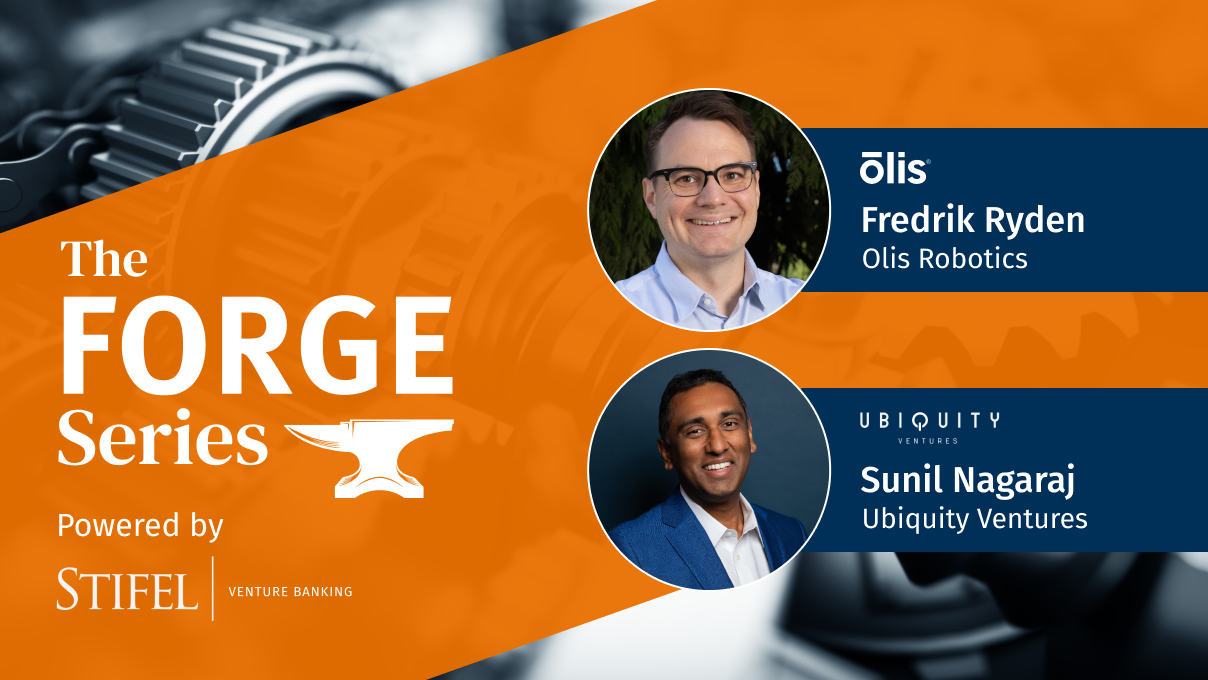
The FORGE Series highlights the founders and experts driving Deep Tech innovation. Hosted by Stifel Bank’s Venture Banking team, these conversations explore industry trends, investment insights, and the challenges of building transformative companies. This piece builds on a session from the October 2025 FORGE Conference: “Applying ML and LLMs to the physical world.”
For Deep Tech founders who build for physical industries, “go time” is now.
AI capabilities have moved from theoretical to practical at remarkable speed. Agents, larger context windows, faster model development, and more flexible architectures are making it possible to solve problems that once required enormous engineering teams, complex integrations, and long deployment cycles.
This shift is especially notable in industrial environments. AI can now monitor fleets of machines, interpret complex operational data, identify what’s failing and why, and surface recommendations from across hundreds of systems.
At the same time, most large organizations, including those in industrial sectors, now have some version of an AI mandate. They may not know exactly what they need yet, but they know they cannot ignore it.
Sunil Nagaraj, founder and managing partner of Ubiquity Ventures and Fredrik Ryden, founder and CEO of Olis Robotics, explored this moment with Matt Trotter, managing director of Stifel Venture Banking, surfacing advice for Deep Tech founders hoping to meet the moment.
It’s time to design for AI agents, not people
One of the biggest shifts of the past year is also one of the least discussed: founders may no longer be building software primarily for human users.
Software no longer needs to be human-first. AI agents can now reason across data, workflows, and system outputs, which means companies can increasingly point agents directly at software. The “user” may not be a person clicking through an interface. It may be an agent querying data, interpreting system performance, taking action within defined limits, and surfacing recommendations to the people responsible for operations.
That changes what good product design looks like. In this emerging world of “Agent Experience” (AX), founders need to think beyond elegant visual interfaces. The priority becomes making software practical, reliable, and fast for agents to use. That means designing APIs, tool definitions, error handling, authentication, permissions, and data structures around how agents actually work.
This has important implications for adoption, too. In many industrial settings, the barrier to digital transformation hasn’t been a lack of need. It’s been the operational burden of deployment, training, and behavior change. If AI can work through existing systems, interpret messy operational data, and reduce the amount of human upskilling required, the path to value becomes shorter.
Define the fence before you deploy
AI agents that affect the physical world can create real consequences when they fail. In physical systems, failure has a “blast radius.”
That means founders can’t only design for what the agent is supposed to do. They have to design for what happens when it does the wrong thing, encounters uncertainty, receives bad inputs, or fails in an unexpected way.
For many industrial sectors, this is a highly solvable problem because the environment is more controllable than the open world. In a factory, warehouse, robotics cell, fleet operation, or industrial automation setting, founders can often define the operating context, constrain the agent’s permissions, and build systems that fail safely.
The fence can take many forms: clearly defined failure modes, permissioning, human approvals, diagnostics breakpoints, operating limits, audit trails, and escalation paths. It may also mean using multi-agent architectures rather than one overarching agent, improving governance and resilience by separating roles, responsibilities, and levels of autonomy.
The contrast with self-driving cars is instructive. Autonomous driving has been so difficult not only because the technology is hard, but because the operating environment is almost impossible to fully fence. Roads are open systems, and edge cases are everywhere, forcing agents to make decisions in a dynamic, unpredictable world.
Industrial founders may have an advantage precisely because many of their target environments aren’t open-ended. The controllability of the environment matters as much as the capability of the agent.
For founders building in operationally bounded contexts, that creates a structural opportunity. They can move faster than companies trying to deploy AI into unconstrained environments, as long as they are disciplined about autonomy, governance, and failure modes from the start.
Make trust part of the architecture
Customers are being pitched constantly, and their build-versus-buy calculation is shifting in real time. This means customer trust, relationships, and domain knowledge are more important, not less.
This is especially true in industries that don’t think of themselves as early technology adopters: manufacturing, logistics, agriculture, transportation, and industrial services. The operational pain is real.
But founders who walk in with an entitled ROI pitch, who tell customers they are obviously wasting money and should fix it, tend to lose those relationships before they even get started.
The best founders in this space are more than just technically strong. They’re socially embedded. They build real connections with customers. They understand constraints, incentives, procurement cycles, labor realities, safety concerns, and the internal politics of deploying new technology. They also understand that the champion inside a large organization may be putting their own credibility on the line.
A black-box model operating inside a physical system needs something to counterbalance uncertainty. Part of that comes from technical design: guardrails, observability, escalation paths, and controlled autonomy. But the path to adoption increasingly depends on the founder’s relationship with the customer: whether they understand the workflow, respect the constraints, and have earned enough trust to help the customer take a calculated step forward.
Go off the beaten track, not off the deep end
This moment rewards ambition, but founders should be thoughtful about the size of the swing they take.
A useful rule of thumb: Avoid betting on two unknowns at once. The hardest companies to build are often the ones that have to create both the product and the customer. “World’s first X” plus “brand-new market” can mean taking on technical risk, market education risk, adoption risk, and go-to-market risk all at once.
The strongest opportunities right now tend to come from one of two places.
The first is bringing new technical capability to a market with known demand. In this case, customers already understand the problem, have budget for it, and can quickly tell you whether your solution is materially better. The founder is not inventing demand, but bringing a better answer to a question the market is already asking.
The second is applying technology that’s finally mature enough to unlock industries that have historically been difficult to reach. Technologies like LiDAR, computer vision, and now AI agents often begin as expensive, experimental capabilities before becoming reliable and affordable enough for markets that could not previously absorb the cost or complexity.
That creates opportunity in sectors like field services, independent trucking, commercial agriculture, local government, and industrial services. These markets may not have deep software cultures, but they often have large operational budgets and real pain points.
As barriers fall, the opportunity shifts from building the best AI to building the most trusted one. The founders who win will understand that the hard part is not always the technology. In many cases, it was always the go-to-market.
Meeting this moment and the next
Nine months ago, the question was whether this was the right moment. The answer now is yes—and many founders could already be late.
But the winners will not simply be the companies that move fastest. They will be the ones that are surgical about which unknown they are actually betting on.
They will know whether they are taking technical risk, market risk, adoption risk, or go-to-market risk. They will build for AI agents, not just people. They will understand their failure modes, and will define the fence before expanding autonomy.
And perhaps most importantly, they will earn the trust of customers whose operations depend on their technology working.
Stifel Venture Banking is a division of Stifel Bank, Member FDIC. For informational purposes only. Stifel Bank does not provide legal, tax, or other advice.
Written by

Related Insights
Other articles designed to help you along your financial journey.