Distributed Energy and Distributed Compute: How to Finance the Future of Infrastructure
Venture Banking

Highlights:
- Electricity demand is surging, putting new pressure on an already constrained grid.
- Distributed energy can provide a faster path to power by adding capacity closer to where it is needed.
- Scaling DERs creates a financing challenge as portfolios grow across assets, contracts, and counterparties.
- Portfolio financing can unlock deployment at scale by aggregating assets and diversifying risk.
- AI-assisted diligence can improve financing efficiency by reducing transaction costs and accelerating review.
- Distributed compute is following the same path, with edge and inference data centers deployed in the same small increments, on the same distribution system.
- The two asset classes underwrite alike, as portfolios of standardized assets whose terms follow the quality of each revenue stream.
The Problem
The US electric grid was built for a different era. In the grid of the past, large, centralized power plants supplied electricity through long transmission lines to customers whose energy demand grew alongside population growth. From 2020 to mid-2025, energy consumption rose just 1.8%.1 Electrification of everything, and the AI boom, have fundamentally shifted the demand profile, forcing the grid to undergo rapid, wide-scale adaptation.
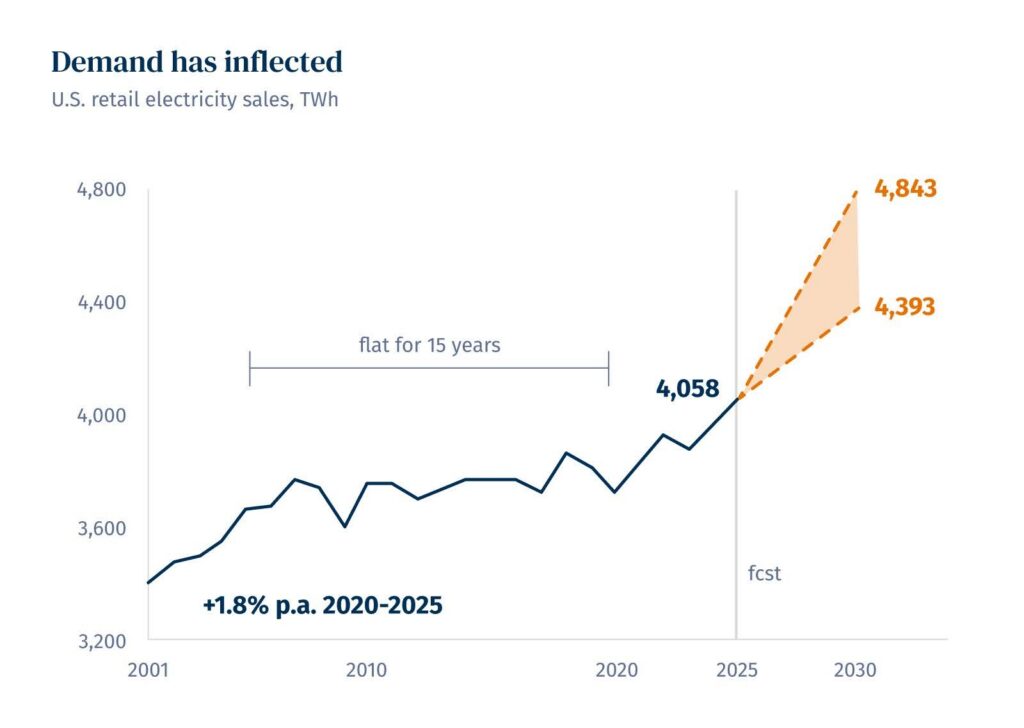
Utility forecasts now point to roughly 166 GW of peak demand growth by 20302 – a sharp break from the essentially flat growth expected only a few years ago. Data centers account for the largest share of that projected increase, with the rapid expansion of AI contributing to the surge in new large loads. Re-industrialization, manufacturing, and broader electrification are adding to it.
The scale of demand gets a lot of attention, but the harder question is how quickly the power system can actually respond.
Much of the country’s grid infrastructure was built decades ago, transmission expansion remains expensive and time-consuming, and more than 2,000 GW of generation and storage capacity is currently seeking grid interconnection3. Connection timelines also remain long.
The challenges presented by the data center buildout echo the challenges with energy infrastructure buildout – large data centers take too long to build, struggle to receive local permits and approvals, and face serious local opposition during and after construction.
In fact, opposition to large-scale data center buildout is one of the few consensus opinions in the U.S. In a March Gallup poll, 71% of Americans said they would oppose the construction of a data center in their area4. This reaction holds consensus across political and geographic lines, meaning hyper-scalers have no easy out to concentrate construction near supportive populace. This consensus opposition has made slowing the speed of data center development into a key political position, with politicians on the right5 and left6 halting data center development approvals, and banning new construction outright.
The Solution
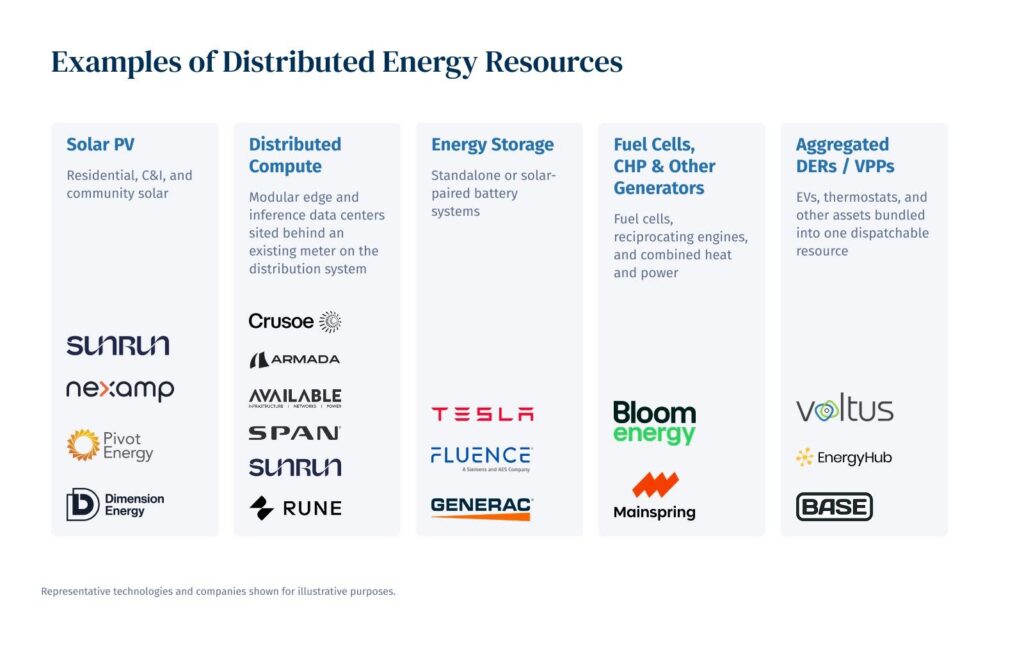
Distributed energy resources (DERs) are not a new concept. For years, resources such as onsite solar, battery storage, fuel cells, reciprocating engines, combined heat and power, along with virtual power plants that aggregate and coordinate distributed assets, have promised to bring generation and grid flexibility closer to where electricity is consumed. What has changed is the urgency of the problem those resources can help solve.
Why distributed energy matters more now
For much of the past decade, DER implementation – while theoretically beneficial – was not essential as market conditions did not create a forcing function for grid transformation. Demand growth was relatively modest in much of the country, and the economics of deploying distributed resources continued to present challenges. Even as technology costs declined, customer acquisition, integration, and other non-hardware costs remained meaningful barriers7 to broader adoption.
Today’s environment is materially different. Electricity demand is accelerating at a breakneck pace while expansion of the traditional transmission system remains difficult, increasing the value of generation that can be deployed in smaller increments and closer to load. Combine DERs with an insatiable appetite for compute, and there could be a world where these two assets are married together harmoniously.
Distribution-level projects can offer several advantages. They may avoid the transmission interconnection queue, benefit from Fast Track interconnection frameworks, require less extensive network upgrades, reduce the distance electricity must travel, and relieve pressure on constrained portions of the grid. In some cases, distributed generation or storage can also defer traditional transmission and distribution investments, serving as what utilities often describe as a non-wires alternative. Modularity adds another advantage.
Consider the difference between developing one 100 MW generating asset and twenty 5 MW distributed projects. While the exact timeline will vary by market and technology, smaller projects can often move through development and construction in parallel rather than depending on a single large project and one interconnection timeline.
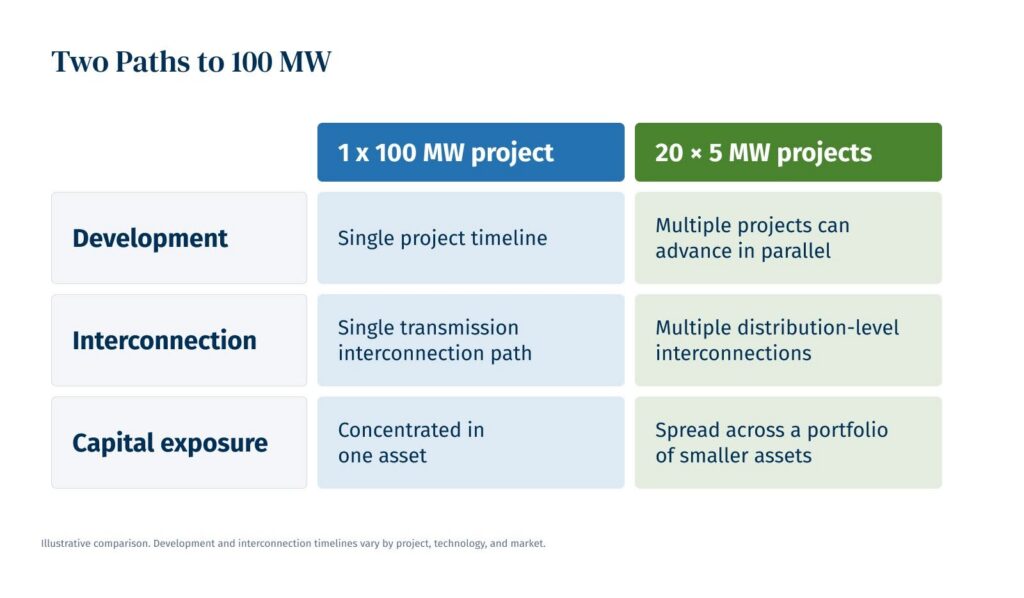
For customers that need power sooner, and for developers looking to bring new capacity online while larger grid investments progress, that flexibility can be increasingly valuable. But realizing those advantages at scale depends on solving another challenge: how to finance a growing portfolio of distributed assets efficiently.
The compute side is going distributed, too
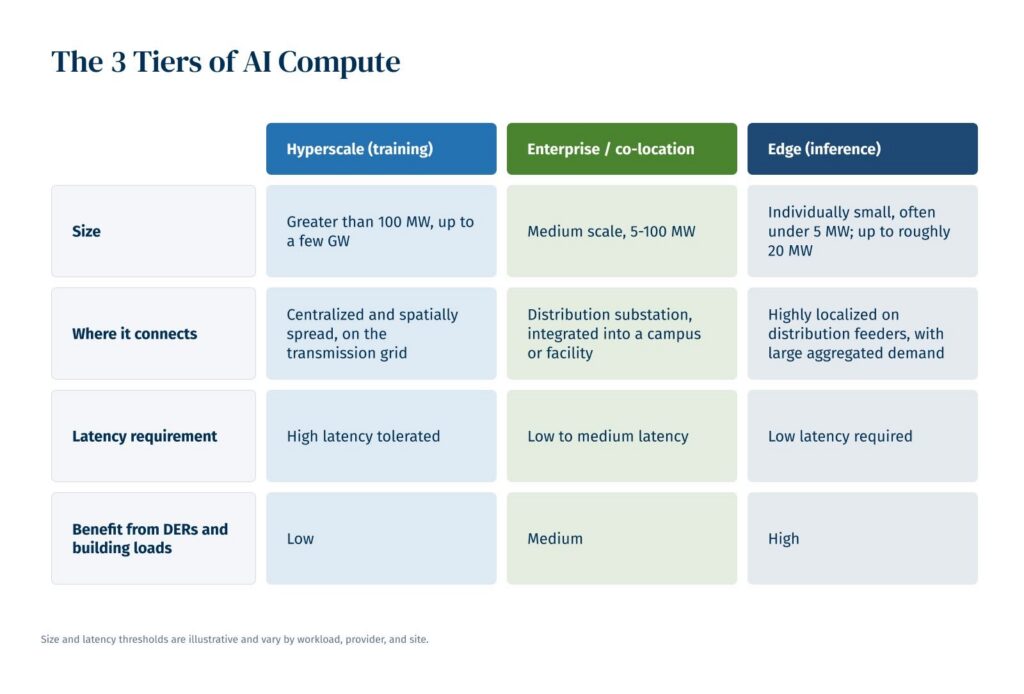
The demand that is straining the grid is itself beginning to decentralize. Roughly 90% of AI-related data center power demand growth8 today is driven by model training, which is centralized by physics: it happens once, on tens of thousands of tightly coupled chips, at campus scale. By 2030, that ratio is expected to invert, with close to 90% of AI workloads shifting to inference.
Inference behaves differently. Each request is independent and latency-sensitive, so it runs better in many small nodes near users than in one large campus. That makes edge data centers, generally under 20 MW and often under 5 MW, the preferred deployment for inference workloads. The three tiers of AI compute now look less like one market than three, as shown in the table.
The equipment has followed the workload. In transactions we have reviewed, modular compute units sized in the hundreds of kilowatts are delivered on a truck, set with a forklift, and tied into an existing electrical panel, energizing in a matter of weeks. Where a site already has utility service and site control in place, contract to first revenue can run in months rather than the three to six years a new large-load grid connection can require.
Distributed Compute is in its infancy as an approach. Publicly, there have been a few notable announcements about distributed compute; 1) Span launched XFRA, a distributed data center solution9 that uses Nvidia chips to mount GPU compute nodes on homes and commercial sites, and plans to launch a pilot deploying 100 nodes on homes by the end of Q3 2026; and 2) Sunrun announced a distributed AI compute pilot10 launching July 2026, placing inference nodes on homes that already have Sunrun solar + storage installed. Privately, our team has received a number of requests to discuss distributed compute, with everyone from established distributed energy developers to early-stage startups looking to join the rush.
Two asset classes, one set of attributes
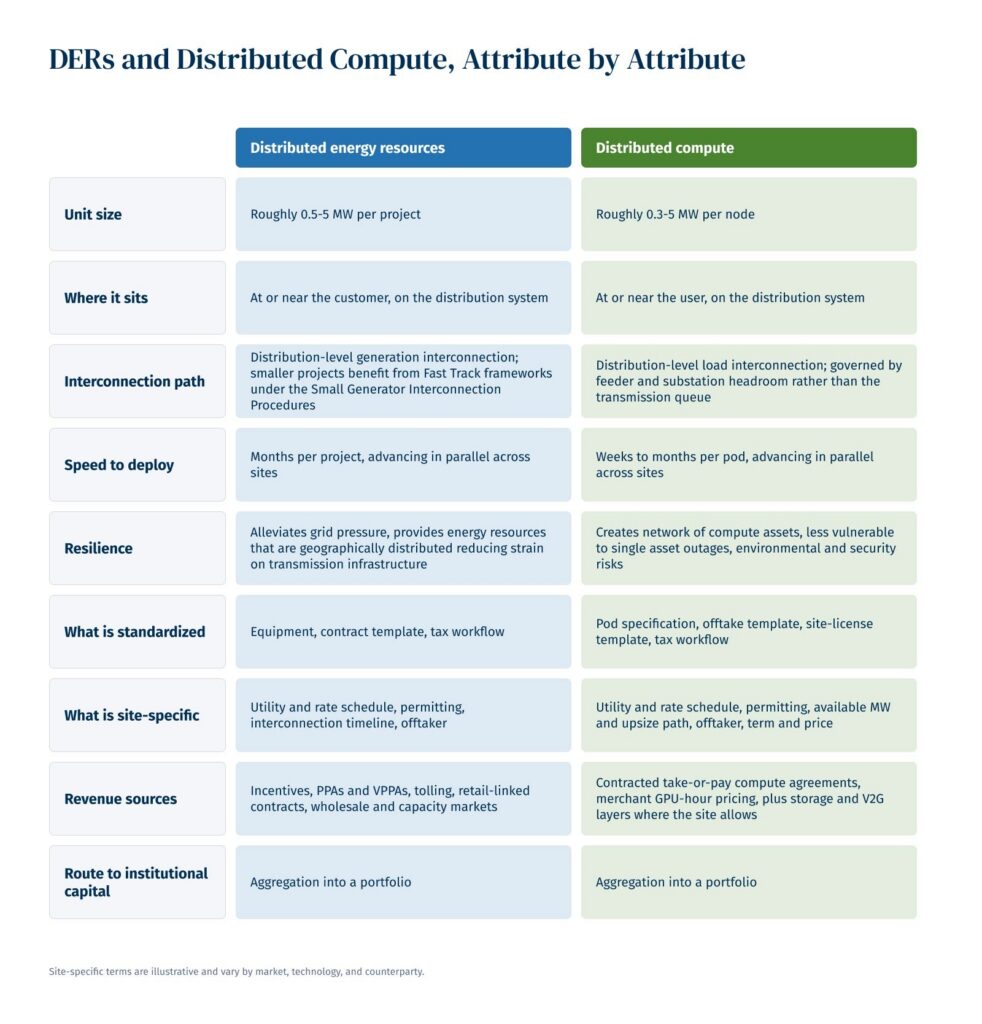
Set side by side, a distributed energy portfolio and a distributed compute portfolio are close to the same asset. Both are built from small, standardized units; both sit on the distribution system near the customer they serve; both are individually immaterial and collectively material; and both reach institutional capital only through aggregation.
The real scaling challenge is financing
Financing one distributed energy project is manageable. The economics become more challenging when sponsors need to execute dozens or hundreds of individual transactions.
Each project brings its own site, contracts, counterparties, revenue streams, construction schedule, and operating profile. Financing them individually can quickly add transaction costs and complexity, eroding some of the economic advantages of distributed energy.
Portfolio financing offers an alternative. By aggregating multiple distributed assets into a single financing structure, sponsors can approach a larger pipeline as one investment rather than a series of unrelated transactions. The structure can also diversify exposure across geography, counterparties, technologies, and revenue sources.
Over the course of 15+ years of financing sponsors deploying distributed energy technologies, including businesses in relatively early stages of commercialization, our team has seen the financing question evolve. Earlier in the market’s development, the focus was often on whether an individual technology or revenue model could support institutional financing at all. Today, sponsors are increasingly asking how to structure capital efficiently across a growing pipeline of assets and sources of cash flow.
In our experience, the answer starts well before a portfolio reaches the financing stage. Decisions around project contracts, revenue structures, counterparty concentration, and how assets are added to the portfolio can all affect financing capacity. Sponsors that consider those factors early are better positioned to build portfolios that can scale with their capital needs.
A portfolio should not be treated like one large power plant
Traditional project finance is often built around a single asset with a defined set of contracts, risks, and operating assumptions. Applying the same underwriting mindset to a distributed portfolio can miss one of its defining characteristics: individual assets do not need to behave identically for the portfolio as a whole to perform.
Distributed portfolios may draw revenue from government or utility incentives, power purchase agreements, retail-linked contracts, wholesale markets, or some combination of those sources. Individual sites may be delayed, customers may change, and projects may perform differently than expected. Each source of variability carries its own counterparty and cash flow risk.
The financing structure therefore has to be designed around variability and flexibility. Diversification across offtakers and revenue sources, appropriately sized reserves, concentration limits, and leverage and coverage requirements matched to the predictability of different cash flows can help limit the impact of any one asset, counterparty, or revenue stream on the broader portfolio. The team’s financing framework, for example, applies different debt service coverage expectations depending on whether revenue is tied to incentives, contracted PPAs, retail markets, or wholesale markets.
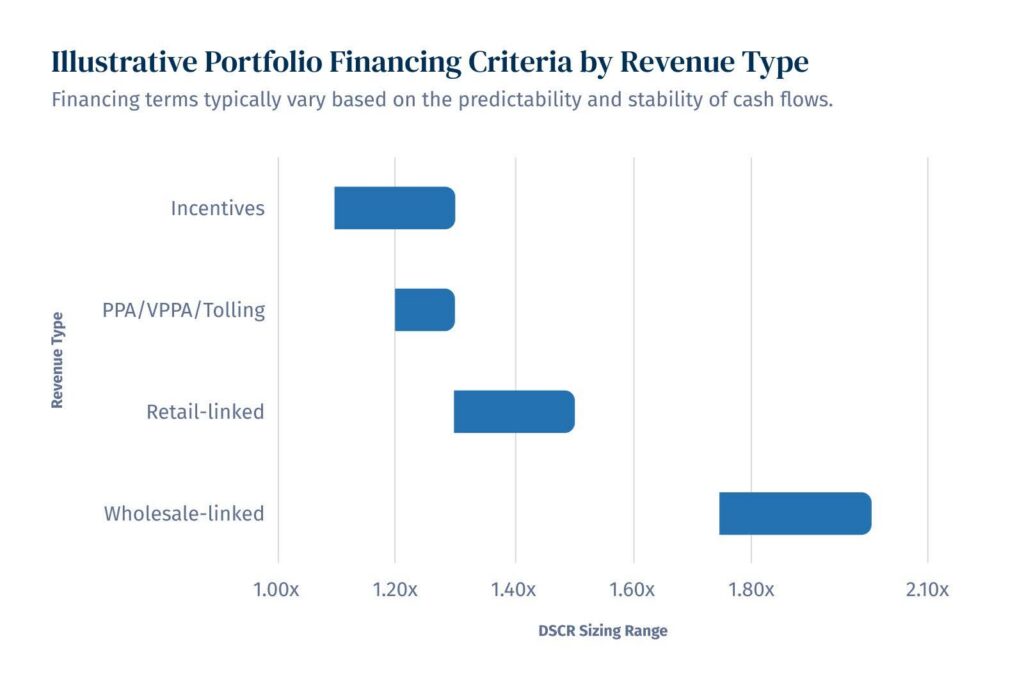
Portfolio financing can turn asset-level complexity into a portfolio-level advantage. Rather than concentrating capital in the performance of one project, a well-structured portfolio can spread exposure across assets, locations, counterparties, and revenue streams.
Portfolio financing is a risk-management tool, allowing financing terms to reflect how distributed assets actually perform and generate cash flow.
Distributed compute underwrites like a DER portfolio
The financing framework for DERs is largely unchanged when applied to distributed compute – many small assets, one facility, and terms set by the predictability of each revenue stream rather than by the certainty of any single site. A contracted, take-or-pay compute agreement sits toward the front of the coverage hierarchy in much the same way a contracted PPA or tolling agreement does; merchant GPU-hour exposure belongs toward the back, alongside wholesale power. Concentration limits, sized reserves, collateral assignment of the offtake agreements, a lockbox for collections, and step-in rights with estoppels at each layer of site control do the same work in both asset classes.
Matching the capital structure to the opportunity
Distributed energy has been discussed as the future of the power system for years. The difference today is that several forces are converging at once.
Electricity demand is surging as transmission constraints groan under the strain of high demand, increasing the value of speed to power. Distributed technologies add capacity in smaller increments and closer to the point of consumption, while the tools used to aggregate, underwrite, and finance those assets continue to advance.
Scaling the market will require capital structures to evolve alongside the technologies themselves.
For sponsors, financing strategy should begin well before a portfolio is ready to raise debt. Decisions made during development, including contract structures, counterparty mix, revenue sources, concentration limits, and the pace at which assets enter the portfolio, can ultimately influence how much capital that portfolio can support and on what terms. Building with those considerations in mind can be more effective than trying to retrofit a financing structure after dozens of assets have already been developed independently.
We believe this will become increasingly important as distributed energy moves into its next phase of growth. The market is moving beyond proving individual technologies toward a new challenge: turning pipelines of smaller assets into financeable portfolios capable of attracting capital at scale. As electricity demand accelerates, pairing modular energy resources with equally scalable financing structures may become one of the defining factors in how quickly new capacity reaches customers.
The convergence now includes the demand side. As inference displaces training as the dominant workload, the compute driving load growth is itself becoming modular, distribution-connected, and portfolio-financed. Sponsors and lenders who already know how to turn many small energy assets into a financeable portfolio are, in our view, unusually well positioned for that shift. The asset is different. The underwriting discipline is largely the same.
Stifel Venture Banking is a division of Stifel Bank, Member FDIC. For informational purposes only. Stifel Bank does not provide legal, tax, or other advice. Representative companies shown and technologies are for illustrative purposes only. Reference to or inclusion of any company or product does not constitute an endorsement, recommendation, or indication of a financing relationship with Stifel Bank.
Written by

Sayoji Goli
Managing Director, Project Finance

Bret J. Turner
Managing Director, Project Finance

Bella Shealy
Vice President, Project Finance
Related Insights
Other articles designed to help you along your financial journey.