As the Manufacturing Environment Shifts Rapidly, How Are Deep Tech Founders Adapting?
Venture Banking
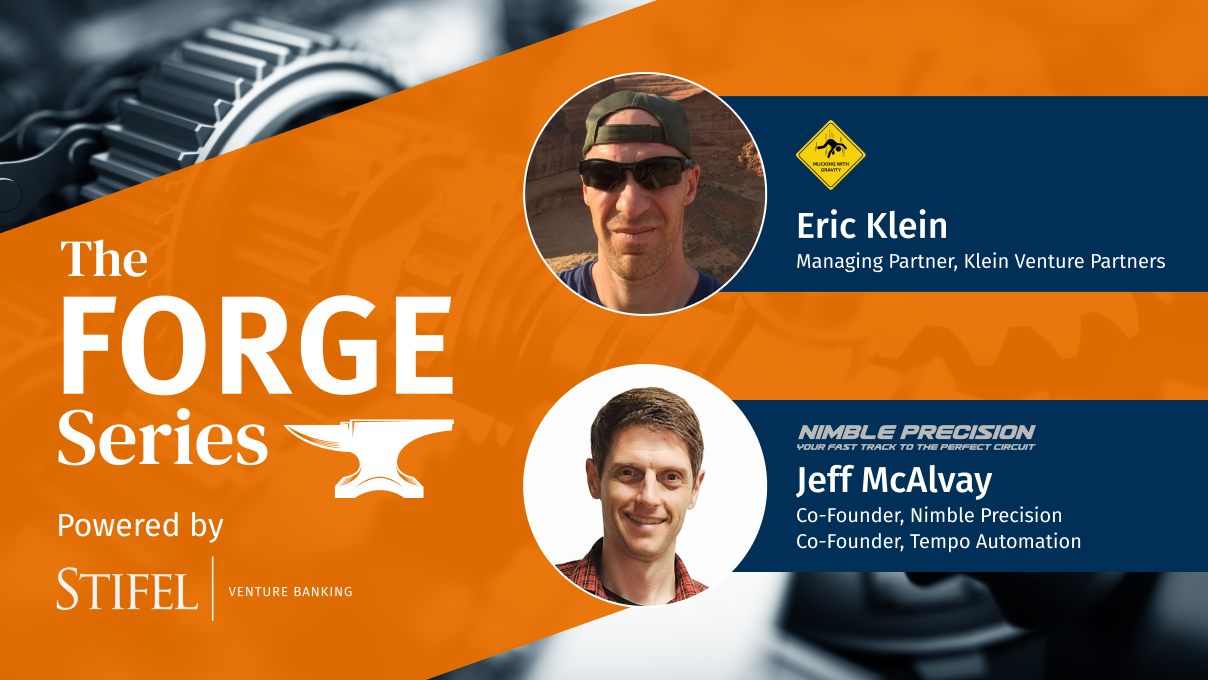
The FORGE Series highlights the founders and experts driving Deep Tech innovation. Hosted by Stifel Bank’s Venture Banking team, these conversations explore industry trends, investment insights, and the challenges of building transformative companies. This piece builds on a session from the 2025 FORGE Conference: “Reindustrialization: Funding and Building Advanced Manufacturing in America.”
Deep Tech founders have always dealt with hard problems.
Designing hardware that doesn’t exist yet. Proving physics. Building manufacturing processes from scratch.
But the past several years have introduced a different kind of hard: operating environments have become unstable in ways that no amount of engineering brilliance can fully address.
Tariffs move component costs by hundreds of percent in weeks. Supply chains go from reliable to unavailable overnight. Geopolitical dynamics rewrite sourcing assumptions before a product reaches market. Unit economics that looked like a business six months ago now require a board conversation.
In this article, Eric Klein, Managing Partner of Klein Venture Partners and a partner at Lemnos, and Jeff McAlvay, co-founder of Tempo Automation and co-founder of Nimble Precision, work through what this environment means for founders building physical products in America.
The Operating Environment Has Fundamentally Changed
The volatility that Deep Tech founders are navigating today is a structural shift in how the global manufacturing ecosystem operates, and the pace of change has little precedent for most people.
Across boardrooms and engineering meetings, the same pressures are appearing simultaneously: component pricing that swings by hundreds of percent in weeks or months; geopolitical restrictions that make previously reliable supply chains inaccessible; tariffs layered on top of underlying cost volatility that were already straining unit economics.
Any one of these would be manageable. All of them at once, in a world where founders are also trying to close rounds and hit revenue milestones, is new territory.
The practical consequence is that financial models built even six months ago may no longer reflect reality. For founders who raised capital to execute a specific plan, the plan has changed.
The Vertical Integration Question: More Complicated than the Poster Children Suggest
When supply chains become unreliable, the instinctive response for many founders is to bring more in-house. Build the capability yourself. Control the inputs. Doing so, however, is complicated.
Vertical integration requires capital that most founders don’t have
The companies that can successfully verticalize share one thing in common: extraordinary capitalization.
“If you want to say ‘do everything yourself’ to get around the supply chain problem, you have to be capitalized in such a way to keep that manufacturing capability available constantly. That is incredibly expensive. Only space and humanoid robotics can support that right now, and it’s difficult even for them.”
For most Deep Tech founders, that capitalization simply isn’t available. Verticalization sounds compelling from the stage, but it means carrying manufacturing overhead and capex that compounds over time, requiring continuous reinvestment to stay current, and diverting capital from core product development.
Vertical integration makes sense when suppliers can’t do it
The right supply chain model depends heavily on the relative advantage of in-house manufacturing versus what suppliers can provide.
During production, if suppliers can hit the cost targets and deliver the scale that customers want, customers will tend to work with them. If not, the incentive to do it in-house increases.
That being said, even companies with a reputation for doing things in-house recognize that the cost and skill required to set up, operate, maintain, and continuously upgrade their lines can be a meaningful thumb on the scale in favor of working with third parties.
“If your design isn’t stable as a Deep Tech founder, your supply chain is in a fundamentally different position than once you have a stable product. Both SpaceX and Stoke have said publicly: if a supplier exists that could meet our demand, we would use them. In a lot of cases, there’s just no part yet.”
The implication for founders is that supply chain strategy shouldn’t be treated as a fixed decision. It should evolve with the state of the supply base. By analogy, before Amazon Web Services, Microsoft Azure, or Google Cloud existed, it made sense for companies to run their own data centers. When those players came online, however, it made sense for software companies to stay closer to their core competencies.
The New Supply Chain Partnership Model
The alternative to full vertical integration is a new category of supply chain partner that can span both phases of development.
Historically, the economics of manufacturing forced a choice. Pre-production partners who could handle rapid iteration and frequent changes were expensive and couldn’t scale. Production partners who could scale efficiently required stable designs and large volumes. The gap between those two phases was where founders got stranded.
AI, automation, and new capital investment in domestic manufacturing are beginning to close that gap.
A new generation of manufacturing partners is emerging that can be agile across both R&D iteration and production scale, absorbing the design changes, ECO management, and turn-time requirements of early development, while also building toward the cost structures that make production viable.
“The dream of aerospace companies is somebody who’ll carry them from development all the way through production. I don’t want to spend all this time getting one group trained up, then start from scratch with another. The promise of software, AI, and higher levels of automation is being able to have the agility to keep up with day-turn iterations, but also a cost structure that lets you compete on the production side.”
These types of suppliers are being built out now for a host of manufacturing processes and, in many cases, are not fully online. It’s new muscle tissue being built in parallel with the companies that need what they make. But the trajectory is real, and for founders thinking about supply chain strategy over a two-to-three-year horizon, it changes the calculus.
For OEMs, the same pressure is creating a different response: a greater willingness to become strategic partners with their suppliers, rather than simply buyers. When geopolitical risk makes international supply chains unreliable, large customers have a new motivation to help bring domestic capability into existence, even if that means engaging early to help shape supplier capability roadmaps, sharing risk, or providing commitments that wouldn’t have been commercially rational before.
Component Alternatives and Pricing Agility: the Tactical Response
Beyond the strategic question of vertical integration versus partnership, there are operational disciplines that founders can build right now to improve their resilience in a volatile environment.
Design for component alternatives from the start
Founders should be asking component alternative questions at the design stage, not after a supply disruption has already hit.
This means more than identifying backup options for critical components. It means designing hardware with component substitutability in mind. Companies need to know which parts have Western alternatives, understand which specifications are truly required versus convenient, and build a map of what happens at the engineering level if any key component becomes unavailable or prohibitively expensive.
AI is beginning to play a meaningful role here, particularly around engineering change order management. When a part needs to be swapped, the process of identifying alternatives, assessing compatibility, and communicating changes through the supply chain is enormously expensive and error-prone. New tooling is starting to make ECO processes faster and more reliable, reducing the cost of adaptation when the unexpected happens.
Move pricing faster than feels comfortable
The second discipline is less technical but arguably more important: pricing agility.
When landed costs change dramatically, the instinct for many founders and sales teams is to absorb it. The fear of losing deals, of affronting customers, of appearing to take advantage of macro conditions creates powerful pressure to protect the pipeline at the expense of margins.
The companies that navigated this most effectively were transparent and fast. They communicated cost changes to customers with the same speed and directness they’d use to communicate a product update, referencing publicly available data on component and tariff changes, making clear that pricing adjustments were cost pass-through rather than margin expansion, and moving quickly enough to preserve the financial integrity of deals in the pipeline.
At the board level, pricing agility is increasingly being treated with the same rigor as supply chain agility. The ability to adjust pricing in response to input cost changes is becoming a core operational competency for Deep Tech hardware companies, not an exception to be managed through sales negotiations.
The Role of Capital in a Volatile Manufacturing Environment
The conventional mental model for lines of credit and venture debt is simple: more cash in the account means more runway and less stress. That’s not wrong. But WIP and BOM are volatile.
“WIP and BOM are bouncing around like ping pong balls in a bingo bowl. When core costs are up 300%, even if you can pass the increase along, something in the middle has to eat that additional operating cash requirement temporarily. That’s what lines of credit do for a living: they smooth the transition between WIP, BOM, and revenue.
In a stable cost environment, that smoothing function is largely invisible. Inventory costs what it costs. Working capital requirements are predictable. The buffer rarely gets tested.
In a volatile cost environment, the buffer is tested constantly. A company with adequate credit facilities and a banking partner who understands its operating model can absorb those gaps without a crisis.
For Deep Tech founders, this means treating capital structure not just as a fundraising question but as an operational resilience question. How much flexibility do you have to carry additional inventory when critical components are at risk of going out of stock? How much buffer exists between a sudden cost increase and the revenue that will eventually cover it? Those aren’t theoretical questions in the current environment. They’re happening to companies right now.
What this Means for Deep Tech Founders
The practical takeaways for founders building physical products in America today are fairly specific.
Build supply chain agility into the product from the start. Component optionality is now a design discipline. Founders who think about component substitutability at the design stage are better positioned when disruptions hit than those who try to adapt after the fact.
Understand the current supply base and its trajectory before committing to a supply chain model. Vertical integration may make sense if there are no good alternatives now and a low chance of there being good ones soon. Vertically integrating is a heavy and expensive commitment as a company scales. The right answer may change as the supply base evolves.
Look for manufacturing partners who can carry you across both phases. The category of partner that can be genuinely agile through R&D and competitive through production is emerging. These partnerships are worth investing in early, before supply chain pressure forces the conversation.
Move pricing faster than feels comfortable when costs change. The companies that preserved their unit economics through the tariff disruptions were the ones that surcharged quickly, communicated transparently, and didn’t wait for customer pushback to make the decision. The customers adapted faster than the founders expected.
Treat capital structure as operational infrastructure. In a volatile cost environment, lines of credit and working capital facilities aren’t just about runway. They’re the buffer between input cost volatility and revenue realization. Founders who understand and use that buffer proactively are in a meaningfully stronger position than those who don’t.
Stifel Venture Banking is a division of Stifel Bank, Member FDIC. For informational purposes only. Stifel Bank does not provide legal, tax, or other advice.
Written by

Related Insights
Other articles designed to help you along your financial journey.