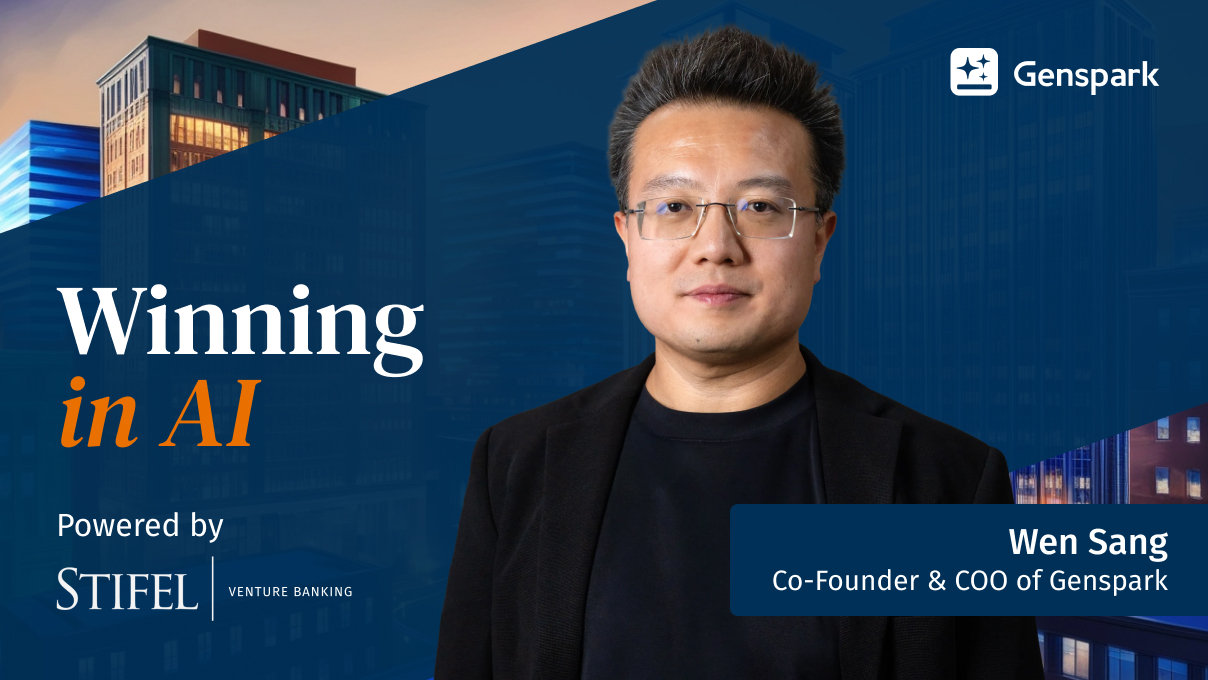
Building for Agents That Work: A Conversation with Wen Sang, Co-Founder of Genspark
Venture Banking
The gap between AI’s promise and enterprise reality is where early-stage companies are finding their footing. In conversations with founders building in high-impact categories, we’re exploring what’s actually working—how they’re differentiating, where they’re finding traction, and what they’re learning faster than anyone else.
Wen Sang has spent much of his career building systems that take work off people’s plates. That was his mission when he co-founded Genspark, the agentic AI company he now runs as COO.
Genspark launched its AI Workspace in April 2025 and has grown quickly in a crowded category, with a stated ambition to serve more than a billion knowledge workers. It recently raised a $100M Series B extension at a $2.6B post-money valuation.
We sat down to talk about where AI agents actually are today, where they’re headed, and what Genspark is learning as it moves deeper into the enterprise.
The big takeaway is that the way forward might not be about building better software. It’s about building users for that software: the agents that do the work and are judged by the quality of what they hand back.
Building AI Agents That Actually Work
In 2026, enterprises expect more than generative AI that talks about the work. Now agentic AI can actually do the work.
That is the bet behind Genspark’s Workspace. The platform is not built for the roughly 30 million software developers in the world. Instead, it is aimed at the billion-plus knowledge workers trying to get through emails, calendars, presentations, financial models, memos, and the dozens of small tasks that fill a workday.
Wen described starting each day with a brief his agents prepare for him: 60 emails came in, three need your attention, here’s a draft reply, tell me if it looks right. The triage, the scanning across channels, the prioritizing of action items—his agents take care of it before he opens his laptop. His agents log into Slack, Gmail, and the rest of the enterprise stack, then operate those systems the way an employee would.
When agents become the workers, something interesting happens: agents, not humans, become the de facto “users” of enterprise software. As Wen puts it, “The tech industry spent twenty years building software tools. We’re building the next generation of users for those tools. We’re not building the tool. We’re building the user.”
Genspark is already testing agents that do more than talk to each other. They actually work together: dividing scope, sequencing steps, and pushing toward a finished deliverable from a single objective. The human sets the goal and approves the results: “I have veto power for everything. Other than that, the agents just run with it.”
The takeaway for founders: If your product assumes a human in the seat, ask what changes when the seat is filled by an agent, and whether you’d rather build that agent or be the surface it acts on. The companies that internalize this early are designing for a different customer than everyone else.
Win on Output, Not Intelligence
Genspark reached roughly two million users within 45 days of launch, but Wen doesn’t attribute this growth to a clever go-to-market campaign. He credits the output it delivered for real customers.
Genspark does not train its own frontier models. Instead, it orchestrates more than 70 of them, with a “super agent” that selects the right model for the right task at the right moment. On top of that sit more than 150 tools the models can call.
His point is that a large language model may provide raw intelligence, but it does not reliably produce finished, real-world work on its own. If the task is to build a chart, for example, Genspark does not simply ask an image model to draw one. The system writes Python in a notebook, renders the chart from the actual data, and then drops it back into the slide.
Two more layers support the same goal:
- Genspark grounds its work in licensed data sets rather than relying only on the open internet, so the output rests on more structured sources instead of whatever happens to be online.
- It runs an in-house evaluation benchmark built around a different goal than the one the frontier labs are pursuing.
Wen explains: “The labs optimize for intelligence. We optimize for whether the email is professional, the deck is information-rich, the model is sound. So we built graders to score that, and the more people use it, the better the system gets at choosing.” It’s a flywheel that drives value.
He described a CFO at a publicly traded real estate company who had tried more than 20 tools to reduce repetitive finance work: quarterly supplements, earnings decks, recurring reports. Genspark, the CFO told him, was the only one whose work product was close enough to “boardroom ready.”
The takeaway for founders: In a market where many companies can access the same underlying models, differentiation moves to the orchestration around them and the precision of your definition of “good.” The company that understands quality most deeply for a specific kind of work, and measures relentlessly against it, has a better shot at owning the output, which is what the customer actually buys.
Adoption Starts With the Person at the Top
Genspark began as a consumer product, but through the second half of 2025, companies began reaching out. Genspark launched its business platform just before Thanksgiving and reached roughly 6,000 business clients within five months, spanning consulting, systems integration, advertising, and consumer brands.
The secret to this success? Wen believes that true AI adoption at an organization requires an internal champion. He’s seen the difference between executives who tell their teams to “go try AI” and executives who actually use the tool themselves.
He pointed to the head of a major systems integrator who became one of Genspark’s heaviest individual users by token consumption, then drove adoption across a team of 20,000, onboarding hundreds of executives in a single week.
“When the leader stops and figures out how to benefit from AI directly, what it does for the team is tremendous. When the leader just delegates it, the team stops moving too.”
One large consulting firm, Wen said, used to spend two months and rely on offshore developers to build a client prototype, billing hundreds of thousands before reaching production. Now, a small team can sit in a room with Genspark and produce several prototypes in a week, at lower cost and with a faster path to revenue.
The takeaway for founders: Enterprise AI adoption is a leadership behavior before it is a procurement decision. A senior champion who personally changes their own workflow is what gets you scaled.
Winning the Innovation Cycle
Asked what he would tell an AI founder starting today, Wen knew what he wanted to say: First, the product has to delight by taking away work people dislike, for example. Second, it has to make things possible that were not possible before.
There’s no slowing down AI development in 2026. When a significant new agent product arrived at the end of January, Genspark shipped its own answer within five weeks because, in Wen’s view, the form factor for how AI serves people had changed for good.
Wen says, “Product-market fit is still real. But its expiration date is short. There’s no moat. You innovate every day, or you’re out.”
Wen says nearly all of Genspark’s code is now written by AI, up from a majority one year ago, and that there are no separate front-end, back-end, design, or DevOps teams. Every engineer is full-stack, commanding coding agents to build the products, which is how a company this size releases something new most weeks.
Underneath the urgency is the reason he’s doing it at all. The end state he describes is one where people are freed from the busy work, where talent is unleashed, and where the choice of how hard to work, a three-day week or a relentless one, becomes genuinely yours.
“What we get is freedom. That optionality doesn’t exist today. Tomorrow, we want to be the company that provides it.”
This is part of an ongoing series of conversations with founders building at the frontier of enterprise AI.
Stifel Venture Banking is a division of Stifel Bank, Member FDIC. For informational purposes only. Stifel Bank does not provide legal, tax, or other advice. Representative companies shown and technologies are for illustrative purposes only. Reference to or inclusion of any company or product does not constitute an endorsement, recommendation, or indication of a financing relationship with Stifel Bank.
Ted Wilson is a Managing Director at Stifel Venture Banking.
Written by

Related Insights
Other articles designed to help you along your financial journey.