Market Insight: Why First-Time VC Fund Managers Outperform – and Why LPs Still Hesitate
Venture Banking

Highlights:
- First-time and emerging managers in VC can create meaningful return potential. Smaller and newer funds often bring sharper focus, distinct sourcing networks, and closer partnership with founders.
- LP hesitation is not simply about performance. Investors also weigh accountability risk, operational uncertainty, liquidity pressure, and the comfort of existing manager relationships.
- Capital concentration has consequences beyond fundraising. When LP capital flows disproportionately to established firms, the range of sectors, geographies, and founder profiles receiving funding can narrow.
- For founders, fit matters more than brand alone. The strongest partner is not always the largest or most recognizable fund, but the investor with the most relevant expertise, engagement, and long-term commitment to the company’s trajectory.
Venture capital has long had a reputation as an industry dominated by established relationships and repeat players. Deal flow tends to concentrate around familiar firms and LP capital often follows known names. Emerging managers in this environment are often treated as higher-risk allocations by default.
There is truth in that framing. But it can obscure something important: first-time fund managers often bring structural advantages that larger platforms may not be able to replicate.
This asymmetry matters because it points to a disconnect between where performance potential exists and where capital actually flows. The second order implications extend beyond LP allocation strategy. They shape which founders get funded, which networks gain influence, and how innovation ecosystems evolve over time.
Experience across venture investing and venture infrastructure makes that disconnect easier to see. The gap between how emerging managers perform and how much capital they attract is rarely just about returns. It often reflects pattern recognition, portfolio construction habits, and the tendency to underwrite familiarity alongside performance.
Where Emerging Managers Gain Their Advantage
The outperformance of emerging managers isn’t accidental, nor is it simply a function of fund size (though size plays a role). Carta fund performance data has shown meaningful TVPI dispersion across fund sizes, with smaller venture funds often outperforming larger peers at the top end of the distribution. This gap consistently appears across multiple vintages, suggesting the advantage may have a structural basis.
Several dynamics help explain why.
Differentiated Networks
Established firms often operate within overlapping ecosystems, which can lead to repeated exposure to the same companies, founders, and intermediaries. Emerging managers frequently source through different channels, often through operating roles, specialized sectors, or founder communities that larger firms do not naturally access.
That does not mean their deal flow is always better. But it is often distinct, and in venture, which intrinsically relies on investments in a combination of disruptive economic potential or non-obvious outlier business creation, distinctiveness can unsurprisingly become an edge.
Operator-Led Pattern Recognition
Many first-time managers launch with a specific strategic focus rather than broad market exposure. When that focus is paired with recent operating experience, it can change both how they underwrite companies and how they support founders.
Focus and Incentives
Emerging managers are usually more concentrated by necessity. With smaller pools of capital, they cannot pursue every category or stage at once. That constraint can create sharper investment discipline, deeper ecosystem relationships, and stronger credibility within founder networks.
The first fund also matters disproportionately. For established firms, a single fund is one chapter in a longer track record. For a first-time manager, the initial fund often defines future fundraising ability and long-term viability as a franchise. That dynamic tends to produce unusually high engagement with both portfolio construction and founder support.
Why Institutional Capital Favors Familiarity
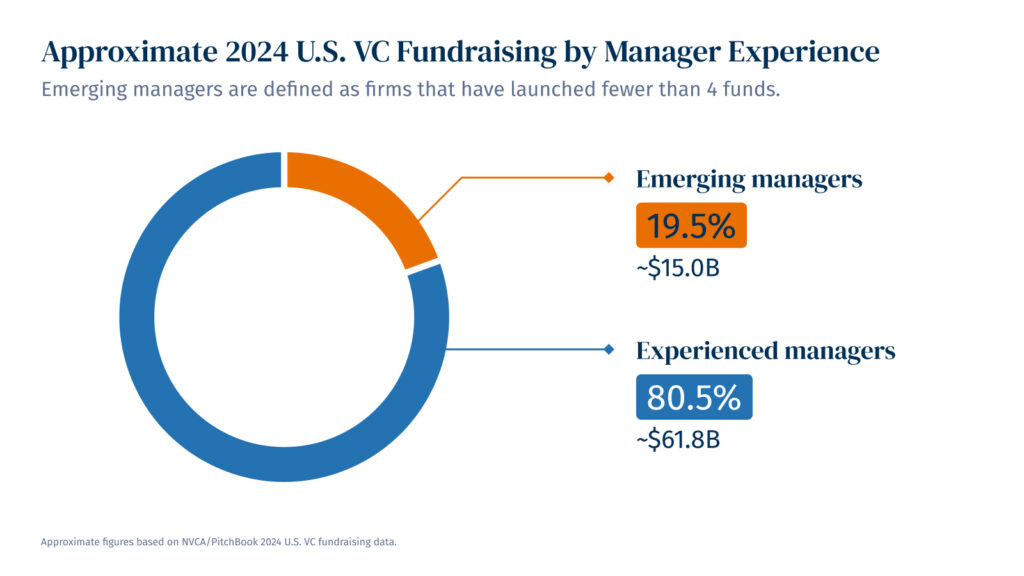
Given the performance case, the capital allocation pattern is striking. In 2024, 30 firms raised 75% of all US venture capital (per Pitchbook), while emerging managers (defined as investors who have raised fewer than 4 funds) captured only $15 billion, their smallest share of commitments since 2015 (per NVCA). Together, those figures point to a broader trend across private markets: capital is increasingly flowing toward the largest and most established platforms.
The imbalance becomes easier to understand when viewed through how LPs manage risk, not just how they assess returns.
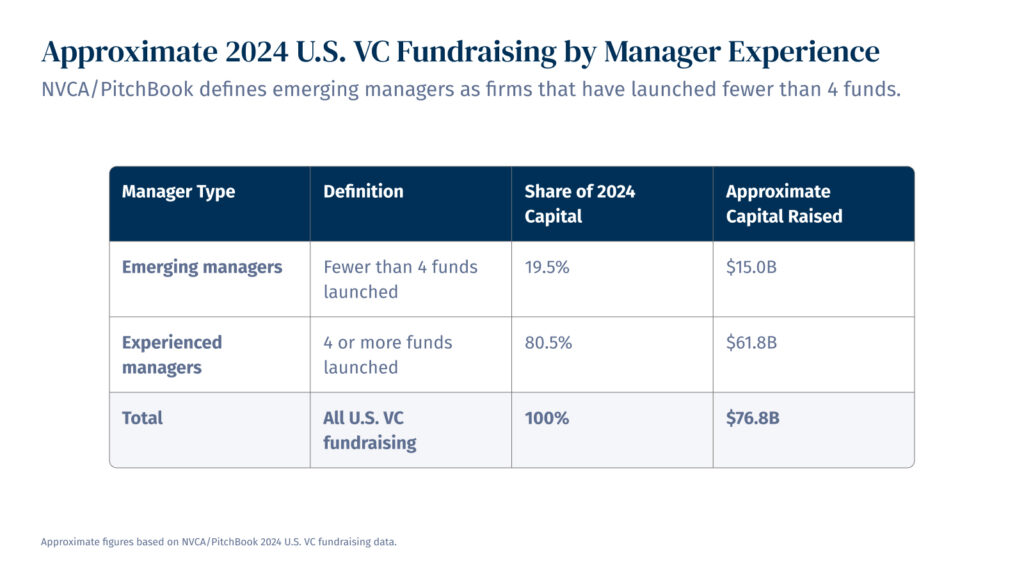
However, it is worth noting that the $15B raised by newer firms is still, on gross, a significant sum. This is enough to support the fundraises of hundreds of new funds, which indeed we see in the data. So while competition has increased, it is still the case that many hundreds of emerging managers, and even first-time fund raisers, have been able to successfully raise new vehicles.
Yes, it has become more difficult for emerging managers, and yes, it may require smaller fundraises, potentially from non-traditional LPs, but clearly many emerging managers have successfully navigated these challenges to claim $15B in new capital.
We should also consider, and may discuss in the future, what this means for early-stage fundraising on the founder and company side, where an epochal shift in how early-stage companies raise capital (or don’t) may well be underway.
Career Risk Matters
For many LPs, backing a first-time manager is harder to defend than recommitting to a known firm. If an established franchise underperforms, the decision is usually easier to explain. If an unproven manager underperforms, the question becomes why the LP took that risk in the first place.
That reality shapes LP behavior. LPs may believe in the upside of emerging managers, but investment committees tend to reward decisions that are defensible, repeatable, and easier to benchmark. LPs have incentives too, after all, and within their own funds these often align not solely with economic outcomes, but also career, political, and other internal decision-making factors.
New Managers Have to Displace Existing Relationships
Emerging managers are not evaluated in a vacuum. They are being compared against firms LPs may have known for years, backed across multiple funds, and built trust with over time. That creates a high bar. A new manager does not just need to be compelling. They need to be compelling enough to earn room in a portfolio that may already feel fully allocated.
Liquidity Has Made the Bar Even Higher
The current environment has made this harder. With IPO and M&A activity still muted, distributions have been slow, leaving LPs with less capital to recycle into new commitments. When liquidity is tight, familiarity tends to win. Even strong emerging managers can find themselves fundraising in a market where LPs are focused less on adding new relationships and more on managing existing exposure.
Infrastructure Still Matters
A compelling investment thesis is not enough. LPs increasingly expect first-time funds to have credible reporting, governance, compliance, and transparency from day one. For emerging managers, operational readiness is table stakes. Without it, even a strong strategy can struggle to clear the institutional bar.
Why the Pattern Persists
The result is a venture market where capital does not always follow differentiated return potential. It often follows relationships, internal incentives, and the path that is easiest to defend when markets are uncertain.
For Founders, Fit Matters More Than Brand
For founders, the investor on the cap table matters well beyond the initial check. The right partner can influence the quality of strategic guidance, the relevance of introductions, and the level of support available during important inflection points.
Emerging managers can be especially valuable at the early stage. They often bring sharper sector context, closer founder relationships, and a more engaged approach. Founders should still be disciplined about what a first-time fund can provide, particularly around follow-on capital and later-stage investor access.
The better framing is less “established or emerging?” and more “which investor is best matched to what the company actually needs?” A first-time manager with deep domain expertise and a thesis tightly connected to the company’s trajectory may be a stronger long-term partner than a larger brand operating with a broader mandate.
Why the Allocation Gap Matters
The gap between emerging manager performance potential and capital access reflects rational LP behavior. Accountability structures, liquidity pressure, replacement risk, and operational diligence all shape how capital gets allocated.
But the larger point is that venture capital is not purely merit-based. Capital does not always flow to the managers with the strongest return potential. It also follows incentives, relationships, and the decisions that are easiest to defend when markets are uncertain.
For founders, that creates a more useful way to evaluate investors. Brand recognition matters, but sector knowledge, engagement, and long-term partnership potential often matter more.
Venture Capital Renews Itself Through New Managers
Venture capital has always depended on new entrants to push the market forward. Emerging managers are often among the first to build conviction around sectors, geographies, and founder networks that larger firms may not yet be watching closely.
Many established AI, healthcare, and sector-focused firms started as emerging managers operating outside the mainstream of capital flow. That matters because when capital concentrates too heavily around existing playbooks, the range of companies and ideas that get funded can narrow.
That is a loss for founders, but it can also be a missed opportunity for LPs. Some of the strongest investment opportunities emerge before they are obvious to the broader market.
Finally, for emerging managers concerned about the enormous competition that now characterizes the space, one of the best decisions you can make is to look for new allies and support systems as you consider the future of your fund. As noted, there were indeed many emerging firms that raised new capital in 2024 (and since), so there are indeed opportunities. Working with a bank or ecosystem player with specific experience working with fund managers is a potentially no-cost step as you plan your way forward.
Stifel Bank, Member FDIC. For informational purposes only. Stifel Bank does not provide legal, tax, or other advice.
Written by

Katya Kohen
Managing Director
Related Insights
Other articles designed to help you along your financial journey.