When AI Meets Your Business: A Conversation with Jaime Davidson, Co-Founder of Omni
Venture Banking
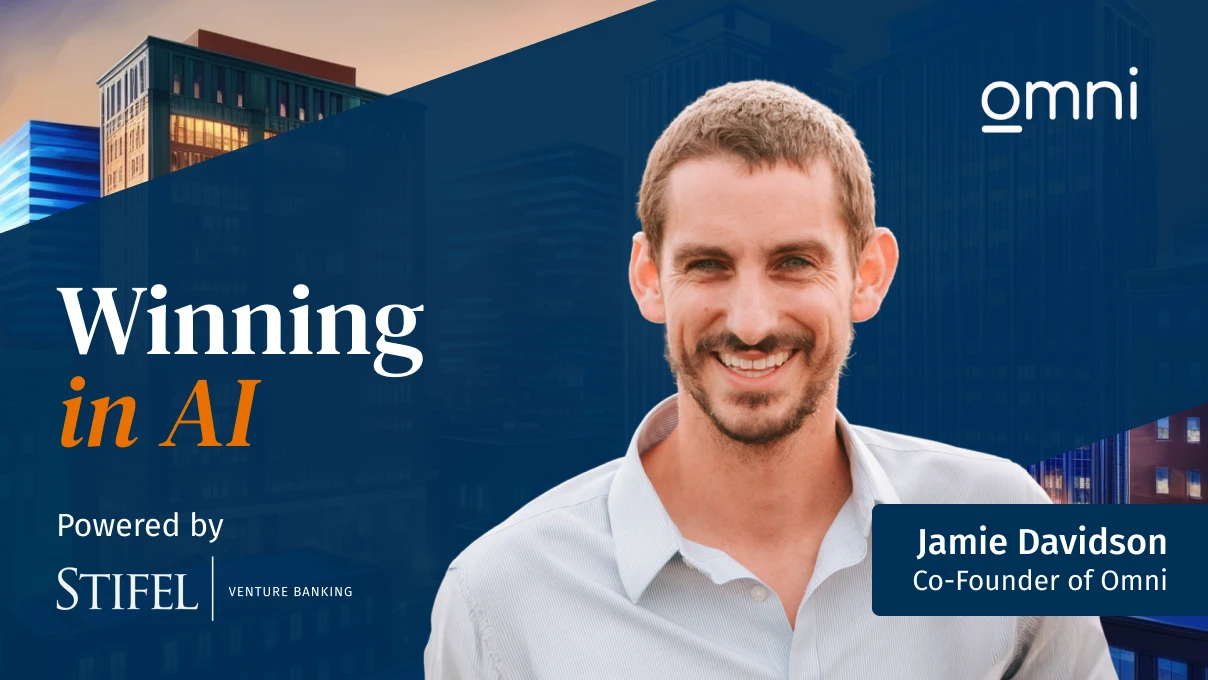
The gap between AI’s promise and enterprise reality is where early-stage companies are finding their footing. In conversations with founders building in high-impact categories, we’re exploring what’s actually working—how they’re differentiating, where they’re finding traction, and what they’re learning faster than anyone else.
Jamie Davidson has spent most of his career thinking about how companies use data: first at Looker, where he ran product and met with roughly 1,500 customers, then at Google after the acquisition, and now as co-founder of Omni, the AI-native analytics platform he launched in 2022 alongside co-founders Colin and Chris.
We sat down to talk about what’s actually changing in enterprise AI, how Omni is building at the moment, and what the market is telling them. Three themes stood out, each with direct implications for how founders should be thinking about building right now.
The throughline: the most important questions in enterprise AI right now aren’t about the models. They’re about the context those models are missing and the founders who understand that earliest have a real edge.
Build the Context Layer, Not Just the AI Layer
Everyone’s using ChatGPT and Claude every day. They look at that ease of use and wonder why they can’t do the same for their own business: ask how the quarter looks, which reps are performing, what’s happening in the pipeline.
The reason they can’t is that natural language is inherently imprecise. “How does our quarter look?” sounds simple. Behind it is a web of unstated assumptions, such as which revenue definition, which time zone, or which teams are included, that a good analyst carries in their head and most AI tools don’t.
“Even if Claude and OpenAI are as smart as Einstein, they know nothing about your business.”
Frontier models are getting smarter every month. But as Jamie put it: “Even if Claude and OpenAI are as smart as Einstein, they know nothing about your business.” The real building challenge is the layer underneath, such as encoding what ARR means at your company, why finance and sales define revenue differently, or what context a sales leader needs versus a CFO, and making that available wherever people are working.
The takeaway is that differentiation won’t come from model selection or prompt engineering. It will come from whoever does the best job of capturing institutional context and making it reliably usable. That’s a harder, slower, more defensible problem than most AI product pitches acknowledge, and it’s where the real moat is forming.
Stay Small Longer Than Feels Comfortable
Omni is roughly 200 people. For a long stretch, Jamie handled all of HR and his co-founder Colin did every invoice and reconciliation himself. They still have no in-house counsel. Contract negotiation, from comparing NDAs, to identifying what’s material versus structural or knowing what needs to go back, all runs through AI tools. Their first G&A hire came around employee 90.
The engineering team tells a similar story. They started with a senior, experienced group of people who’d worked in data infrastructure and enterprise software before and knew the right architecture to build. That team has grown, but nowhere near proportionally to the company. “There’s just a huge amount of leverage we’re getting from engineering,” Jamie said, “and there’s corresponding complexity when you add new people.”
Every engineer at Omni uses tools like Claude Code. The productivity gains are real and compounding. The implication for founders: the natural instinct to hire ahead of need is increasingly a trap. The companies that stay lean and build AI into their operating structure from day one are making a different set of tradeoffs than the ones that staff up and retrofit later. That gap is hard to close.
The Category You’re Selling into May Not Exist Yet
For the first couple of years, Omni’s sales motion looked familiar, with Looker migrations, Tableau replacements, data teams moving to a better platform. That’s changed significantly.
“Increasingly it’s not about taking 200 operational dashboards and rebuilding them,” Jamie said. “It’s about enabling people who’ve never had access to a business intelligence tool before.”
One customer is a large retailer where every support agent uses Omni to understand tickets, customer satisfaction, and team productivity. Another is an SDR manager who used Omni’s AI capabilities to build automated coaching for his entire team and directly attributed the tool to hitting 140% of his number in a single month.
“He’s never logged into a BI tool in his life,” Jamie noted. “This is just a much easier way to engage with data.”
The buyer has shifted accordingly. Deals that used to start with data teams are now coming in through VPs of AI, chief innovation officers, and line-of-business leaders with outcomes to hit. The framing has moved from cost comparison to capability unlock.
“The question isn’t just whether your product works. It’s whether the category you’re selling into matches how buyers are actually thinking about the problem today.”
For founders, this is worth watching closely regardless of what you’re building. When the buyer changes, the pitch changes, the budget changes, and the competitive set changes. The question isn’t just whether your product works, but whether the category you’re selling into matches how buyers are actually thinking about the problem today.
Iterate into the “Fog”
Jamie used the word “blurry” more than once. The competitive landscape is blurry. Where Omni ends and where Claude or ChatGPT begins is blurry. What enterprise software looks like in two years is blurry. His response to that uncertainty is less a philosophy than a discipline.
“Stay as small as you possibly can, as long as you can. Hire for full ownership. And ship constantly, as you don’t learn if you don’t ship.” The fog of war, as he called it, means no one has a reliable view of what’s coming. The only reliable edge is the feedback loop you build by getting things in front of customers faster than everyone else.
That’s not a hedge against uncertainty, but the foundational strategy. In a market where the underlying technology is changing faster than any roadmap can accommodate, speed isn’t a nice-to-have. It’s how you find out if your bet is right.
Jamie Davidson is co-founder of Omni. Ted Wilson is a Managing Director at Stifel Venture Banking, a division of Stifel Bank, Member FDIC. This is part of an ongoing series of conversations with founders building at the frontier of enterprise AI.
Written by

Related Insights
Other articles designed to help you along your financial journey.