How Deep Tech Founders Can Navigate Product-Market Fit
Venture Banking

The Forge Series highlights the founders and experts driving Deep Tech innovation. Hosted by Stifel Bank’s Venture Banking team, these conversations explore industry trends, investment insights, and the challenges of building transformative companies. This piece builds on Timothy Harris’ session from the 2025 Forge Conference.
Why Deep Tech Product Market Fit Breaks the Standard Startup Playbook
I’ve lived this problem personally, and I’ve watched dozens of other founders wrestle with it. There’s nothing clean or linear about taking a technology and trying to find product-market fit (PMF).
In a traditional startup, you start with a market problem. People are thirsty? No lemonade available? Fine—go buy lemons, sugar, and a stand, and you now have a lemonade business. The sequence is obvious: identify the problem, build the solution.
Frequently, Deep Tech works the other way around. A group of PhDs emerges from a research lab or years of engineering experimentation, with an innovative concept or a partially formed complex technology—and only then do you begin the meticulous work of figuring out where it might actually fit in the market.
The Unique PMF Challenges in Deep Tech
When you start with a technology instead of a market problem, the road to PMF comes with a peculiar set of challenges.
Starting with a thesis. Usually, you have some idea of where the technology may go. A new battery chemistry, maybe electric vehicles. A novel protein synthesis—there’s an immune therapy that it might work for. Most founders have an idea of the problems they might be able to solve, but the disconnect comes from taking a general, abstract idea of what they can solve to a real-world environment application with all restraints, competitive existing solutions, industry norms, and standard practices.
Deep Tech takes time. The challenge is compounded by the time it takes to build a truly novel product. You might begin with a true 10x breakthrough, but by the time you’ve turned it into a product, the market has moved. Competitors catch up, and your advantage can shrink to a 2–3x edge.
Battery technology illustrates this well. Research can point to drastic performance improvements, but by the time those batteries hit real deployments, the measured advantage tends to collapse to something like 7%—and often only in specific, large-scale scenarios.
Deep Tech teams are engineering-led. By nature, when you build hard technology, you have to build strong engineering teams. The product often comes later. Design decisions, organizational authority, and culture have been built around engineering, and product has the tough job of coming in and questioning if engineering is truly working on the right parts of the product.
Eventually, every Deep Tech company must empower product leaders to tell engineers what the market actually needs, even when that means using standards or making compromises the engineering team dislikes. What features matter in this vertical? Which tradeoffs actually unlock value? PMF requires those decisions, even when they divert engineering effort away from the core technology. In my opinion, this is the #1 area where Deep Tech companies fail to execute.
“A lot of deep tech companies die while waiting for their market to arrive”
Early customers can be a red herring. Early on, you might land a big customer, often an R&D lab eager to run pilots with your technology. Going all-in on that first customer might work, or it might be a path you don’t want to follow. Not every application will work out in practice. Just look at drone delivery—the technology exists, but there are a thousand reasons it hasn’t come to the real world yet. A lot of companies die while waiting for their market to arrive.
Insight from Swift Navigation: We have over 7,000 customers today, but in a real sense, the majority don’t represent our ideal product-market fit. The markets aren’t big enough, or it just isn’t the best fit for the technology. For instance, we had a professor from a preeminent university who hoped to use our GPS technology to track birds. We love the enthusiasm, but we can’t put resources behind niche use cases that will never scale.
Toward PMF: Understand Your Real Customers
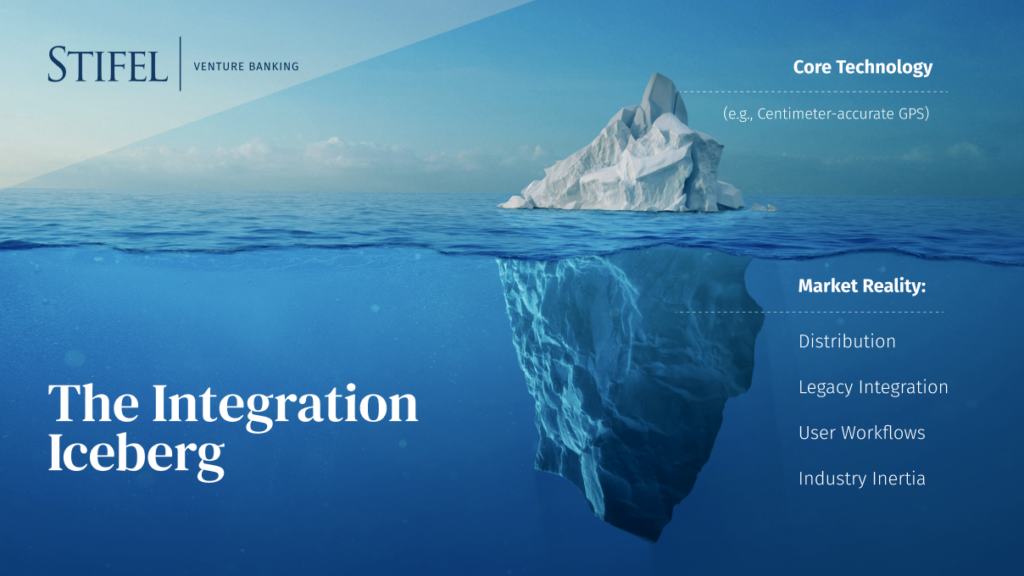
To get to the right product-market fit, you must understand the customer’s reality, not just your technology’s potential.
“Customers don’t buy technology. They buy products”
Customers don’t buy technology. They buy products—and beyond that, they buy integration and distribution. If you have a faster engine but no brakes, no one is buying your car (except perhaps Evel Knievel). Feature parity is a war you can often lose to your incumbent competitors, so product must be clear on what matters and what doesn’t.
Similarly, a beautiful piece of technology still needs to integrate with existing workflows, systems, and data to be useful.
Finally, customers have a way of buying technology in their industry. It’s your job to make buying that technology as easy as possible. If the product, integration, or distribution creates too much friction, it won’t get adopted.
Understand the real user, not just the buyer. It’s easy to get far into development without sitting down with the operators who will actually use your product. The executive sponsor might love your pitch. The day-to-day user may find it irrelevant, incompatible, or too difficult to use in their day-to-day.
Early-stage pilots are a great way to get users’ feedback. I often see founders reject industry user feedback in favor of their product vision, saying they are just too ignorant and backward-looking to “get it.” In the end, the customer is always right, even if they are wrong.
Know the limits of R&D engagement. R&D teams are open to experimentation. Production teams are frequently not. This changes from one customer organization to another, but if these teams are separate, you have a good chance of getting trapped in “R&D hell” with no path to production. Both from a product and a sales side, make sure you’re talking to the right people, testing the right features, and checking the right boxes.
Assume customers don’t want to change. Inertia is the most powerful force in the universe. Customers typically don’t want to change anything unless someone forces them to or the costs are overwhelmingly obvious. There are good reasons why they operate the way they do, even if you, as the founder, don’t understand it.
Be honest about what changes cost them and focus on providing incredible ROI, which is both increasing the value to them and decreasing their cost and/or friction.
Insight from Swift Navigation: When we brought our centimeter-accurate GPS to market, we faced large incumbents with similar, higher-end technology for specialized industries. Our plan was to target the 93% of the market that they hadn’t touched, while disrupting a $10 billion competitor landscape.
We quickly learned that selling into legacy agricultural machines required deep integration with tractors and their data platforms. Those OEMs already had long-term partnerships with our competitors, and farmers had strong brand loyalty. With that level of integration, distribution, and defensibility in place, the market just wasn’t feasible for us. The only viable path was to pursue new markets.
The Path to PMF Belongs to the CEO
Trust me, product-market won’t just emerge by chance—the CEO must actively steer the company toward it. The CEO must hold the torch for the technology, the product, and the customer.
“Product-market fits doesn’t emerge from technology by chance—the CEO must actively drive the company toward it with thorough market testing”
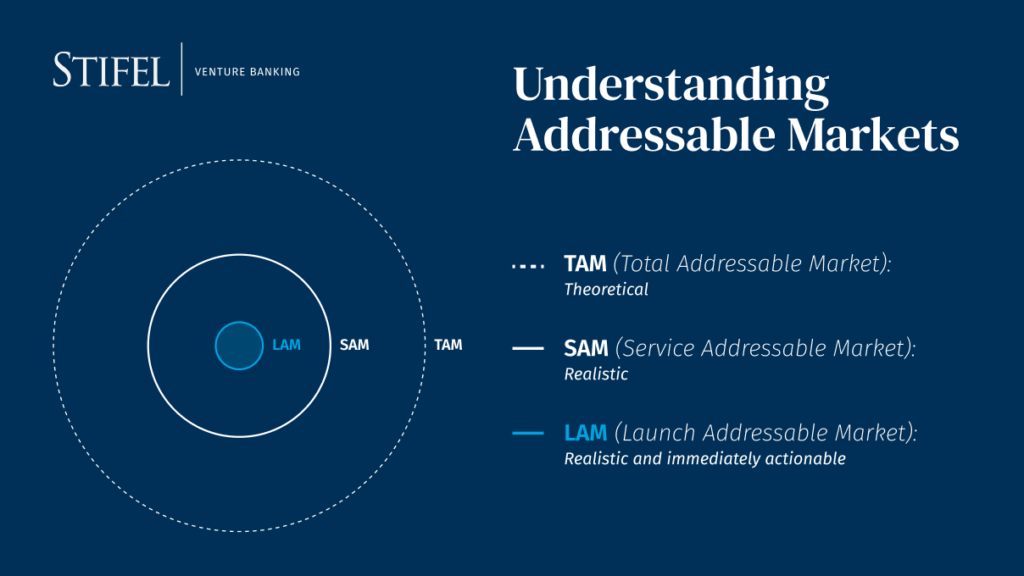
Select the launch addressable market. This isn’t something you can delegate. Sales teams usually cannot do it, and most organizations cannot make this decision collectively. You must understand—with brutal clarity—your launch addressable market (LAM) and the service addressable markets that come after it.
Your LAM must live or die by your innovation being successful, otherwise they likely wouldn’t take the risk. Because your technology’s 10x price or performance improvement makes the customer application possible for the first time, they will accept the pain of fewer features, unpredictable delivery, technical challenges, and a high-risk young startup. Without that focus, you will spend your time chasing feature parity in a nice-to-have market or addressing whichever customers scream the loudest, which guaranteed will lead you off course.
What is a Launch Addressable Market (LAM)? Your realistic, immediate target market when you first launch a product, focusing on who you can reach today. You need to find this before you can scale.
What is a Service Addressable Market? The realistic segment of the market that aligns with your business model, product fit, and geographical reach.
Both are subsets of your Total Addressable Market (TAM), if you were to capture 100% of the market demand. But this is theoretical—you can’t sell to everyone.
Empower product and sales. Culture is set by the CEO. Organizations anchored in Deep Tech naturally prioritize the technology teams. But PMF requires something different: intentionally empowering product and sales teams to drive the customer voice requirements back through the company.
You don’t want to build everything customers ask for, but you do need to understand the solution problem in each vertical you’re entering. That requires building a mixed DNA: half technologists, half industry experts who know how things get bought, integrated, and adopted.
Beyond that, it’s still the CEO’s job to have “taste” in the product decisions, because no one else will have a better sense of what the technology can do, and what the customers pain is.
In my experience, that combination of empowered product, informed sales, and a CEO willing to make hard calls about market direction is what gives Deep Tech companies their best shot at real, durable product-market fit.
Hard tech is harder. So why build a Deep Tech company if it’s easier to build a SaaS platform for a known industry problem? Maybe in a world of AI turning software into a commodity, this has become obvious. Deep Tech is far more defensive, durable, and valuable. But much more than that, Deep Tech is fundamentally about solving incredibly hard technology problems with world-changing consequences, which I think is the best job anyone could ever ask for.
Related Insights
Other articles designed to help you along your financial journey.