Navigating the New MedTech Playbook: What Winning MedTech Companies Are Doing Differently
Venture Banking
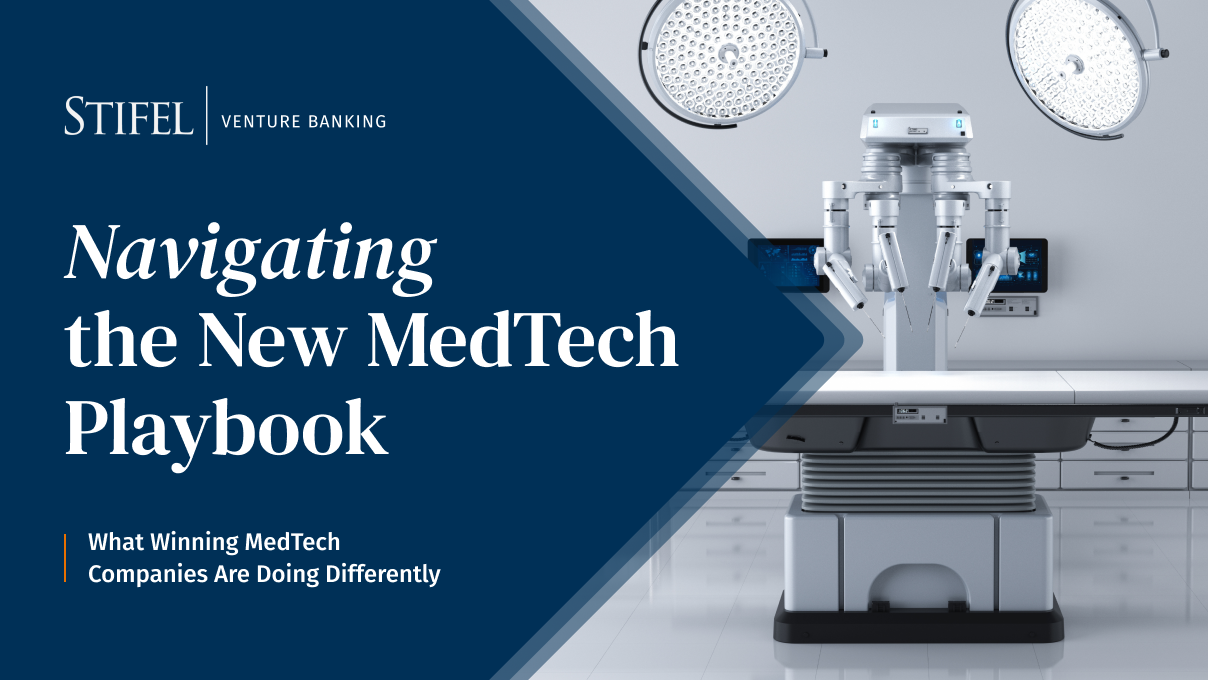
Navigating the New MedTech Playbook is a series from Stifel Venture Banking’s Life Sciences & Healthcare team focused on the operational and financial realities shaping today’s medtech market. Drawing on conference takeaways, client work, investor conversations, and patterns observed across the life sciences ecosystem, the series explores the strategies, decisions, and market shifts shaping how healthcare companies scale in a more disciplined capital environment.
Highlights:
- Capital is available but selective, with large checks going to de-risked companies that are already showing clinical utilization.
- Milestone-driven planning is table stakes, meaning burn should map to fundable moments.
- Venture debt is a planning tool, not a lifeline, so founders should engage early.
- The pre-FDA team is oftentimes not the post-FDA team, which means commercial experience should be in the room before it’s urgently needed.
- Field work before approval is a competitive advantage.
A few weeks ago, our team was at the LSI USA summit. Deal conversations were happening, investors were engaged, and the underlying innovation on display was genuinely impressive. From cardiology and neurology to oncology, the companies drawing the most serious attention were solving large, well-defined clinical problems with strong data behind them.
But underneath the optimism, a clear division was visible. Capital is available (and in some cases, in very large quantities), but it’s flowing with far more precision than it did a few years ago. Investors are writing big checks, but they are writing them for a narrower set of companies: ones that are derisked from a clinical and/or regulatory perspective, seeing repeat utilization in the operating room or clinic, and driving a pathway to future profitability through sufficient reimbursement.
The question worth asking is: what are those companies actually doing differently?
After LSI and from what we see across our clients and broader market conversations every day, a few traits show up consistently.
Milestone-driven capital planning with real treasury discipline behind it
The companies raising efficiently have mapped their capital to milestones rather than to the calendar. They know exactly what it costs to reach their next fundable moment, whether that’s pivotal trial readout, FDA clearance, or first commercial revenue. They’ve built their burn model around getting to these milestones with margin. They’re running scenario-based treasury planning, not just a base-case spreadsheet, and understand what a six-month enrollment delay does to their runway before it happens, not after.
What this looks like in practice is a CFO or finance lead who can walk any investor or lender through three distinct scenarios: base case, downside, and upside. Each scenario has a clear runway figure, a clear set of assumptions, and a clear set of levers the company can pull if things deviate. That kind of preparedness signals operational maturity. It also dramatically shortens diligence conversations, because the questions sophisticated investors ask are already answered before they ask them.
Treasury management is the less glamorous part of this, but it matters more than founders typically expect.
Companies holding meaningful cash balances after a raise need a clear structure for how that capital is held, protected, and earning. FDIC insurance, yield, and the mechanics of drawing down over time can’t be treated as administrative afterthoughts when they are financial decisions with real consequences.
Founders who treat treasury as infrastructure tend to have cleaner financials, fewer surprises at board meetings, and a stronger posture when lenders or investors are evaluating the business.
A capital stack designed with intention, not assembled by default
The companies that are best positioned have also thought carefully about their capital stack holistically rather than evaluating each instrument as it arrives.
Venture debt, when used correctly, is a planned tool to extend runway to a milestone without proportional dilution, or to supplement an equity round from a position of strength. It is not an emergency measure.
The medtech, biotech, and healthcare founders who engage with non-dilutive capital early, when they have leverage, consistently get better structures and preserve more strategic flexibility than those who come to the table reactively. The difference between structuring venture debt from a position of strength with strong balance sheets, clear milestones ahead, and 12-plus months of runway versus doing it with six months left and a delayed trial is not subtle. The terms reflect the company’s posture. And the covenants, draw schedules, and repayment structures that get negotiated in one scenario versus the other can have lasting effects on the company’s options down the road.
The broader point is that capital stack decisions compound. Successful companies think about equity, debt, and hybrid instruments as a system rather than as a series of one-off transactions.
Leadership and board composition that matches the phase
Leadership composition comes up in nearly every serious investor conversation. The current environment is less forgiving of execution gaps, and experienced investors know that clinical, regulatory, and commercial complexity all compound simultaneously in the growth phase.
In medtech, companies are built around solving a clinical problem through engineering, chemistry, and science prior to FDA approval. But once approval comes, the focus shifts almost overnight to commercialization, operations, customer service, and marketing. The team that got the company through FDA is not always the team best suited to scale it.
Boards that include people who have scaled a commercial organization in medtech, managed a payer strategy from scratch, or taken a company through a financing event with real stakes are a meaningful signal. Minimizing execution risk means putting experienced operators in positions where they can make course-correcting decisions quickly.
The bar for when institutional experience needs to be in the room has moved earlier than most founders expect. This doesn’t mean medtech, biotech, and healthcare founders need a full C-suite before Series A. It means they need honest answers to a few questions:
- Who on this team has built and managed a direct sales force in medtech?
- Who has negotiated with a payer before?
- Who has been through a Series B process and understands what institutional investors will look for?
If those answers don’t exist internally, the board should provide them.
Investors are looking for evidence that the team is buildable: that the founders know what they don’t know and have surrounded themselves accordingly. Sometimes, this means founders recognizing limitations and stepping aside for a senior leader who can steer the ship during the next phase of the company.
Early field work as a strategic asset
The companies that are best positioned commercially started their field work well before they received FDA approval. They had real conversations with physicians about adoption and prepared key stakeholders for value analysis committee review. They formed a ground-level understanding of where pricing pressure actually comes from and how reimbursement influences decision making inside health systems.
They’ve also asked the right questions: Do we have a known accessible, cash positive CPT or pass through? What is the true value proposition? What are the real costs?
This kind of intelligence does several things simultaneously.
- It shapes clinical strategy. Feedback from early physician conversations often surfaces protocol questions or workflow integration issues that are far cheaper to address before a pivotal trial than after.
- It informs capital planning. Understanding the realistic timeline from clearance to first covered claim to repeatable revenue is essential to building an honest burn model.
- It makes the investor narrative dramatically more credible. Founders who can speak from experience about how their product moves through the health system, where the friction is, and how they’re addressing it are telling a fundamentally different story than those who are projecting from first principles.
The go-to-market model decision sits inside this same bucket. Whether a company builds a direct sales force or goes to market through independent reps is a high-leverage capital decision that too often gets made by default.
Direct means higher fixed cost, deeper clinical engagement, and better brand control, which is appropriate for complex, high-price-point devices requiring significant physician education. Independent reps mean lower fixed burn and faster geographic coverage, which is better suited for products with established clinical protocols and existing channel relationships. (We’ll cover this more in future posts.)
The right answer depends on product complexity, clinical intensity, and price point. The wrong answer is arriving at it without having asked the question deliberately. The “right” answer will also evolve as hospital dynamics, clinical evidence, and surgeon adoption change over time.
The part that ties it all together: focusing on fundamentals
The throughline across all of it is simpler than it sounds. This perspective shows up clearly in how experienced investors are framing the market:
“Private companies should ignore public market noise and stay focused on fundamentals like clinical outcomes, reimbursement, and a scalable, repeatable commercial model. The companies that win are the ones that do the hard work regardless of what the market is doing.”
Public market sentiment shifts. Macro headlines move investor psychology in ways that have nothing to do with the underlying science.
The companies navigating this environment most effectively are the ones that don’t let any of that reshape their strategy. They stay grounded in clinical evidence, reimbursement logic, and a commercial model built to be repeatable and scalable. They hit the next milestone. Then the one after that. Problems will arise, but with experience and expertise, they can be corrected to keep the company on course.
This is where clinical conviction becomes the foundation for everything else.
Investors want to see strong, specific, reproducible outcomes in areas where the unmet need is large and well understood. The pressure to demonstrate that clarity has moved earlier in the company lifecycle than it used to. The valley of death now sits most acutely between seed and Series A, and the companies that cross it are the ones that make hard choices about where to focus and build evidence accordingly.
Capital is there. It is concentrated, and it is demanding. But for founders with strong clinical data, a disciplined capital strategy, experienced teams, and a commercial foundation built with intention, the environment is genuinely workable.
The new playbook isn’t more complex than the old one; it’s just more honest. Know your milestones. Manage your cash. Do the hard work. Use every tool available. Surround yourself with others who have expertise where you don’t.
This article is part of Navigating the New MedTech Playbook, an ongoing series from Stifel Venture Banking’s Life Sciences team exploring trends shaping medtech, healthtech, and biotech companies. Stifel Venture Banking Life Sciences & Healthcare is a division of Stifel Bank, Member FDIC.
Written by


Related Insights
Other articles designed to help you along your financial journey.