The Operational Finance Gap that Appears After Series A
Venture Banking
Highlights:
- Series A to Series B is a financial systems transition, not just a growth phase. As companies scale, finance operations, governance, and capital planning must evolve alongside the business.
- Founders must balance today’s operations with tomorrow’s fundraising. Runway, reporting, treasury, and capital planning all become interconnected well before many startups hire a CFO.
- Financial infrastructure becomes a competitive advantage. Strong treasury, reporting, and capital strategy can streamline fundraising, build investor confidence, and preserve flexibility.
- Preparing early creates more options later. Companies that strengthen their financial architecture before it’s needed tend to scale more smoothly and avoid preventable friction.
- The right banking partner can help bridge the gap. Startup-focused banking expertise can help companies mature their financial operations while preparing for the next stage of growth.
Series A is the milestone founders spend years working toward. It signals product-market fit, investor conviction, and in the most common narrative a readiness to scale. The team grows. The roadmap expands. The pressure to execute intensifies.
What the narrative rarely captures is what happens next.
The period between Series A and Series B is one of the most consequential stretches in a company’s life, yet one of the least discussed. The challenge here is structural rather than growth-based. The financial systems, governance habits, and capital decision-making processes that worked at the seed stage begin to show their limits – often quietly and at the worst possible moments.
Across venture-backed companies, the pattern is consistent enough to be worth naming: an operational finance gap opens after Series A, and most founders don’t see it until it’s already creating friction.
When Startups Begin to Grow Up
Before Series A, most organizations operate with a financial setup that is intentionally simple. Treasury may consist of a single operating account. Financial decisions run through the founders. Capital instruments are minimal. Governance is light, reporting is informal, and the CFO function, if it exists at all, is often handled by a founder wearing three other hats.
This simplicity is appropriate at this stage.
After Series A, the picture changes faster than most teams anticipate. Board reporting expectations formalize. Hiring accelerates, increasing the complexity of payroll, benefits, and cash flow timing. International entities or new markets may enter the picture. Venture debt and other structured capital tools move from nice-to-have in theory to practical need. Investors who were once supportive observers become engaged stakeholders with real governance expectations.
The business may still look like an early-stage startup from the outside, but financially it must begin to operate like a system – one that supports a broader set of decisions, stakeholders, and constraints.
For many companies, the challenge here is that their financial architecture hasn’t evolved to match that shift.
Founders Suddenly Have to Look Down and Look Up at the Same Time
One of the defining pressures of the post-Series A phase is the need to operate across two financial horizons at once.
Looking down means managing the operational layer: burn rate and runway, payroll and cash flow timing, improving the discipline of financial reporting, and ensuring the business has the visibility it needs to make day-to-day decisions with confidence. This is the work of keeping the business running.
Looking up means managing the strategic layer: preparing for Series B, designing the capital stack, evaluating whether venture debt or other structured capital fits the company’s trajectory, and maintaining flexibility as market conditions evolve.
In a more mature organization, these functions are typically separated. Finance teams, systems, and processes handle the operational layer, allowing leadership to focus on strategy.
Most post-Series A startups don’t have that separation yet. Founders are often bridging the CFO and COO roles simultaneously, without the infrastructure larger organizations rely on. As a result, decisions across both horizons are frequently made reactively, without a clear framework for how they interact.
The gulf between Series A and B (however defined) is a classic chasm in VC-backed startup financing. The median deal size at the Series B is roughly double that for the Series A (seen below with data spanning 2020 to mid-2026). This roughly 2x gap has been relatively stable going back to 2020 with some spikes in the gap in 2021.
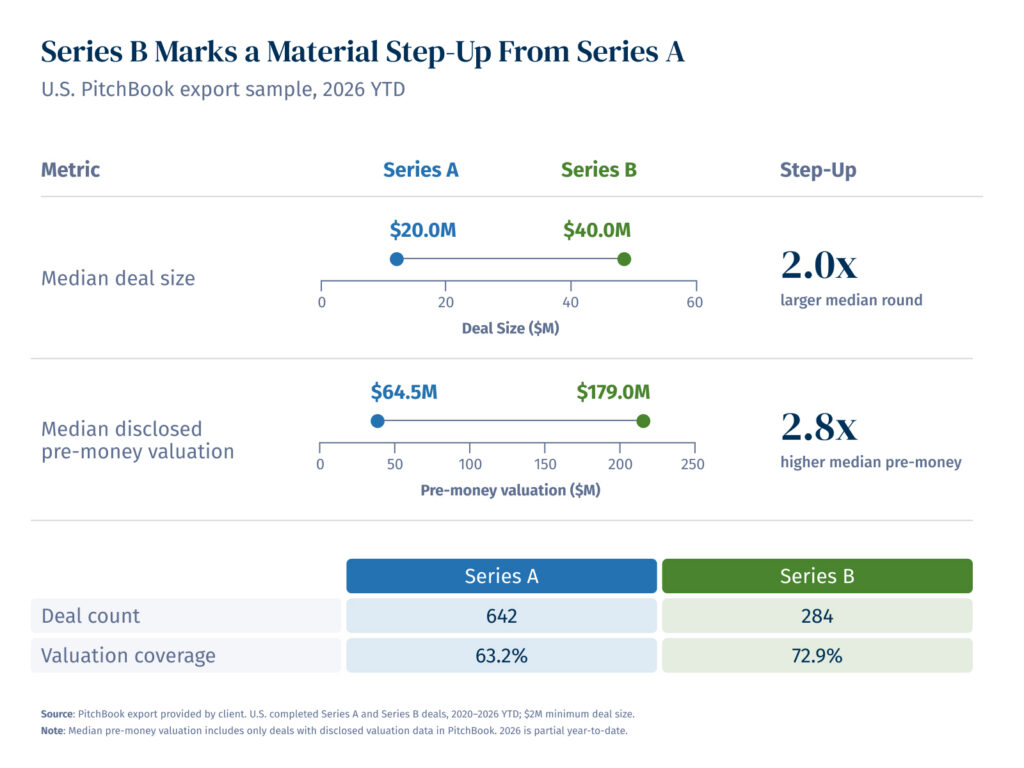
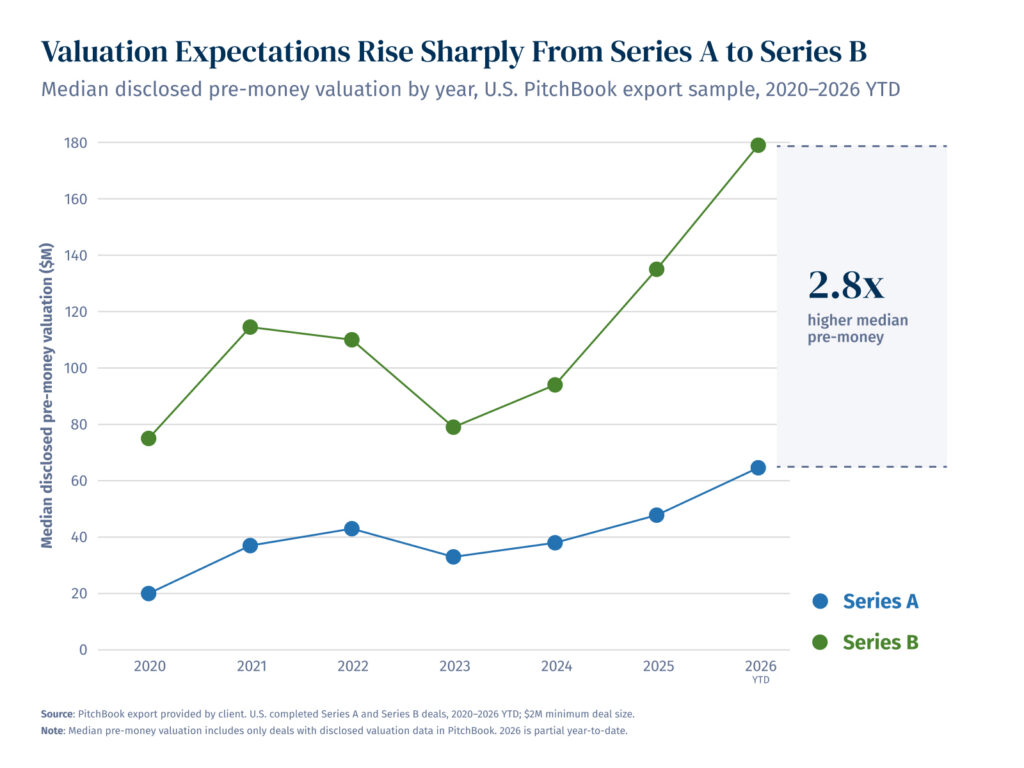
But the median pre-money valuation now in 2026 increases almost 3x at the Series B, demonstrating the non-linear equity valuation expectations that investors begin to demand at the B round. This valuation separation has been increasing post 2023, correlating with observations that Series B rounds tend to be where investors first begin to demand valuation step-ups, though also a result of prices for companies that raise B rounds in the first place being bid-up in the market.
Regardless of the dynamic, it is clear that the jump from A to B is not merely more capital in a successive round, but a statement about the company’s maturity and sophistication as well as a new responsibility to justify its rapidly growing valuation multiple versus when it was a Series A company.
Where the Gap Actually Appears
The operational finance gap rarely presents itself as a single, identifiable failure. It shows up as friction in fundraising conversations, diligence processes, debt discussions, and moments when decisions need to be made quickly without all the available information.
Across startups at this stage, three patterns appear most consistently:
Treasury becomes a bottleneck.
Treasury is often the first place the gap becomes visible. Early configurations are built for simplicity and speed – a single operating account, minimal structure, and limited need for segmentation. That setup works fine when the business is small and predictable.
As the business scales, the need for clear cash visibility, segmentation between operating and reserve capital, and disciplined liquidity management increases. Companies that haven’t evolved their treasury infrastructure often discover the gap mid-decision, when clarity matters most.
Capital decisions are made transaction-by-transaction rather than strategically.
After Series A, founders encounter a much wider range of capital options: venture debt, equipment financing, revenue-based structures, and bridge instruments. Each is typically evaluated in isolation, tied to an immediate need.
The problem is that capital decisions compound. A structure that looks attractive in isolation can constrain flexibility six months later. Companies that think in terms of capital design – how different instruments interact over time – tend to navigate financing events with significantly more leverage.
Financial infrastructure lags behind growth.
Product and engineering infrastructure tends to scale quickly in high-growth businesses. Financial infrastructure often doesn’t. Reporting remains manual, forecasting models become increasingly fragile, and visibility into the business becomes harder to maintain.
The systems that should be producing clean, reliable financial intelligence instead produce noise. While this may not create a visible problem in day-to-day operations, visible problems emerge when a sophisticated investor, lender, or acquirer asks for details.
Why This Phase is the Most Consequential
The Series A to Series B period is when many of a startup’s highest-leverage decisions are made. Hiring accelerates, market expansion begins, and capital strategy becomes more complex. These decisions shape not just growth, but how the business is evaluated in its next round.
These decisions don’t require perfection, but they do need clarity: a grounded view of the current financial position, a realistic model of future cash needs, and a capital stack designed to support the strategy rather than constrain it.
Companies that arrive at this phase with stronger financial architecture tend to move through fundraising more efficiently, maintain greater strategic flexibility, and operate with fewer surprises. Those that don’t often experience friction not because the business is failing, but because the systems supporting it haven’t kept pace.
Closing the Gap
What separates the startups that navigate this transition well is an early mindset shift: financial operations stop being treated as administrative overhead and are instead treated as infrastructure.
In practice, this means a few specific things:
Treating treasury as infrastructure rather than administration.
Cash visibility is a decision-making function. Knowing exactly where cash sits, how it’s protected, how it earns, and how it can be deployed quickly is the kind of clarity that enables confident action. Companies that invest in treasury structure before they need it rarely regret the decision.
Designing the capital stack proactively rather than reactively.
The best time to think about venture debt, bridge financing, or other structured capital instruments isn’t when the need is urgent. It is when the business has leverage. Founders who understand the full range of capital tools available to them, and how each one interacts with their equity structure and strategic plan, tend to make better decisions at every subsequent financing event.
Building CFO-level visibility before the formal CFO hire.
Even before an organization has a CFO, it needs the information CFOs produce. Clean financial statements, realistic forward models, clear runway visibility, and a coherent capital narrative are all valuable long before a CFO hire is made. Founders who build that visibility early, whether through fractional support, a strong controller, or disciplined internal processes, are better positioned at every moment that visibility matters. In addition, being prepared financially, whether it’s the narrative, the actual financial statements and projections or demonstrating how the company’s capital journey has interacted with its performance and management decisions, can improve investor confidence and even support stronger valuation conversations. Investors tolerate a certain level of financial simplicity in startups because they are young, small companies. But as the Series A becomes the Series B, investors begin to expect at least some of the financial sophistication that characterizes mature private equity businesses looking to raise capital.
Aligning financial systems with growth plans deliberately.
Financial infrastructure should be designed with the company’s 18-to-24-month roadmap in mind, not the current state. If international expansion is on the horizon, the treasury and reporting architecture should anticipate it. If a Series B process is 12 months away, the reporting cadence and financial narrative should be in a state of readiness to support that.
The Structural Shift No One Warns You About
The transition between Series A and Series B is about more than growth. It’s a structural shift that changes the fundamental nature of what the business is and how it operates.
Startups that reach Series A have learned to move fast and make good decisions with limited information. Those skills remain essential, but they are no longer sufficient on their own. The company now requires financial systems that can support scale, capital structures that preserve flexibility, and decision-making frameworks that match the complexity of the business.
Startups that recognize this shift early tend to move faster, raise capital more efficiently, and maintain optionality as markets change; they also will likely command higher valuations as financial sophistication conveys both managerial competence and signals financial stability to venture investors who are often especially concerned with these particular dimensions. Those that do not tend to discover the gap at exactly the moment they can least afford to address it.
Financial architecture rarely creates momentum on its own. But without it, momentum becomes much harder to sustain.
Written by

Related Insights
Other articles designed to help you along your financial journey.